सत् Spirituality & Religion

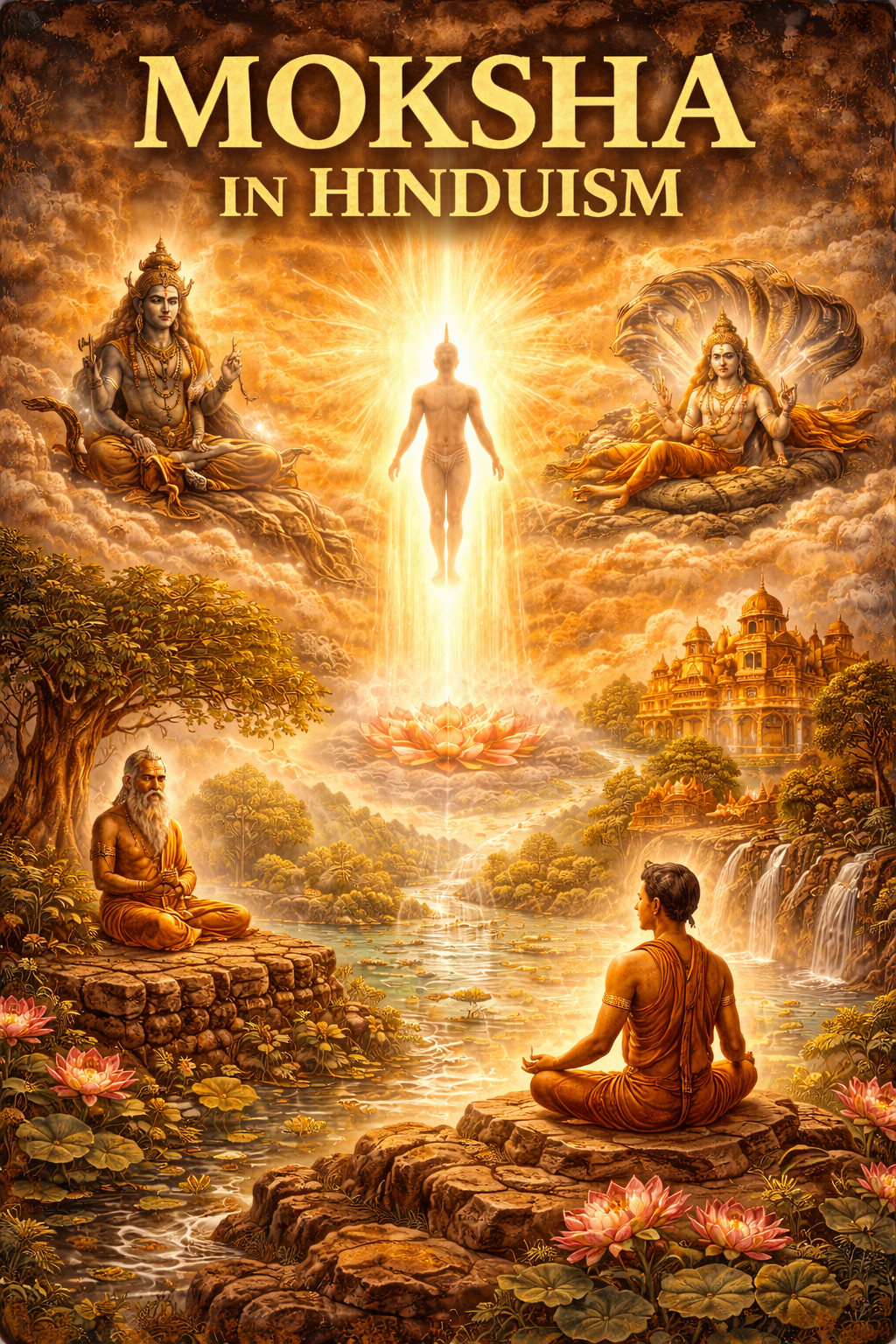
Moksha in Hinduism

Moksha in Hinduism — The Ultimate Freedom Every Soul Is Searching For

There is a longing that lives beneath every other longing. Beneath the desire for love, for success, for security, for meaning — beneath all of it, quieter than all of it, there is something else. Something that no achievement has ever fully satisfied. Something that no relationship, no experience, no accumulation of any kind has ever permanently touched. That longing is the soul’s memory of its own freedom. Moksha in Hinduism is the name given to that freedom — not as a distant theological promise, but as the most immediate, most available, most urgently relevant truth in the entire canon of human wisdom. It is the liberation that ends not just this life’s suffering but the entire cycle of birth, death, and rebirth that has carried the soul through existence since before memory begins. At Moksh Prapti, Moksha is not our subject. It is our name. It is the reason we exist. मोक्ष कोई दूर का लक्ष्य नहीं है — यह उस चेतना की पहचान है जो सदा से मुक्त है, केवल अज्ञान के कारण बंधी हुई प्रतीत होती है। Moksha is not a distant goal — it is the recognition of a Consciousness that has always been free, only appearing bound due to ignorance. What Is Moksha in Hinduism — The Foundation The word Moksha comes from the Sanskrit root muc — to release, to liberate, to set free. In Hindu philosophy, it is one of the four Purusharthas — the four aims of human life — alongside Dharma (righteous living), Artha (material prosperity), and Kama (desire and pleasure). But Moksha is not simply the fourth aim on a list. It is the aim that gives meaning to all the others. It is the destination toward which all of human life — all its joys, all its sorrows, all its striving and resting and losing and finding — is ultimately oriented, whether or not the individual soul is yet aware of this. Hindu philosophy is unambiguous about what Moksha is and what it is not. Moksha in Hinduism is not: Moksha in Hinduism is: This distinction matters enormously. Moksha is not something you earn. It is something you recognise. And the entire apparatus of Hindu philosophy — the Vedas, the Upanishads, the Bhagavad Gita, the various schools of Vedanta — exists for one purpose: to facilitate that recognition. The Four Paths to Moksha in Hinduism Hindu philosophy has never insisted on a single road to liberation. It has always understood that human beings come with different temperaments, different strengths, different relationships to the sacred — and it has mapped, with extraordinary precision, the paths most suited to each. Jnana Yoga — The Path of Knowledge Jnana Yoga is the path of direct inquiry into the nature of the Self. It is the path most closely associated with Advaita Vedanta and with teachers like Adi Shankaracharya and, in the modern era, Ramana Maharshi. The methodology is simple to describe and demanding to practice: you inquire, relentlessly and honestly, into the nature of the one who is seeking Moksha. Who is the seeker? What is the Self that is supposedly in bondage? Can you find it? Can you locate a separate, limited self anywhere in direct experience — or do you find, on honest investigation, only awareness itself, open and unbounded? Shravana — hearing the truth from a qualified teacher. Manana — reflecting on it until every intellectual doubt is resolved. Nididhyasana — meditating on it until it becomes not a concept but a living, breathing, unshakeable recognition. This is Jnana Yoga. And for the seeker with a sharp intellect and a genuine burning desire for liberation — mumukshutva — it is the most direct path to Moksha in Hinduism. Bhakti Yoga — The Path of Devotion Bhakti Yoga is the path of love — the dissolution of the separate self through complete, unconditional surrender to the Divine in whatever form most naturally calls to the heart. The great bhaktas of India — Mirabai, Tukaram, Andal, Kabir, Chaitanya Mahaprabhu — did not arrive at Moksha through intellectual analysis. They arrived through love so total, so all-consuming, so utterly without reservation, that the boundary between the lover and the beloved simply dissolved. In Advaita Vedanta, this dissolution is understood as the recognition of non-separation — the same recognition that Jnana Yoga arrives at through inquiry. The path is different. The destination is identical. Bhakti does not require a sharp intellect. It requires an open heart. And for the seeker whose nature is devotional — whose relationship with the Divine is one of love rather than inquiry — it is among the most natural and most powerful paths to Moksha in Hinduism. Karma Yoga — The Path of Selfless Action Karma Yoga is the path of action performed without attachment to its fruits — every deed offered as an act of worship, every responsibility met as a form of spiritual practice, every moment of ordinary life transformed into sadhana. The Bhagavad Gita is its supreme scripture. And its central teaching — stated by Krishna to Arjuna on the battlefield of Kurukshetra — is one of the most radical propositions in all of spiritual philosophy: Yogah karmasu kaushalam — Yoga is excellence in action. Not withdrawal from life. Not renunciation of responsibility. But the full, wholehearted engagement with every duty, every relationship, every challenge — performed from a place of inner stillness, without grasping for outcomes or contracting in fear of loss. Karma Yoga does not require a monastery. It requires a kitchen, an office, a family, a life — and the willingness to meet all of it with complete presence and zero attachment. For the seeker whose life is full of worldly responsibility, it is the path that makes Moksha in Hinduism not a future possibility but a present reality. Raja Yoga — The Path of Meditation Raja Yoga — the royal path — is the systematic science of meditation described by the sage Patanjali in the Yoga Sutras. Through the progressive

Moksha in Hinduism — The Ultimate Freedom Every Soul Is Searching For Read More »
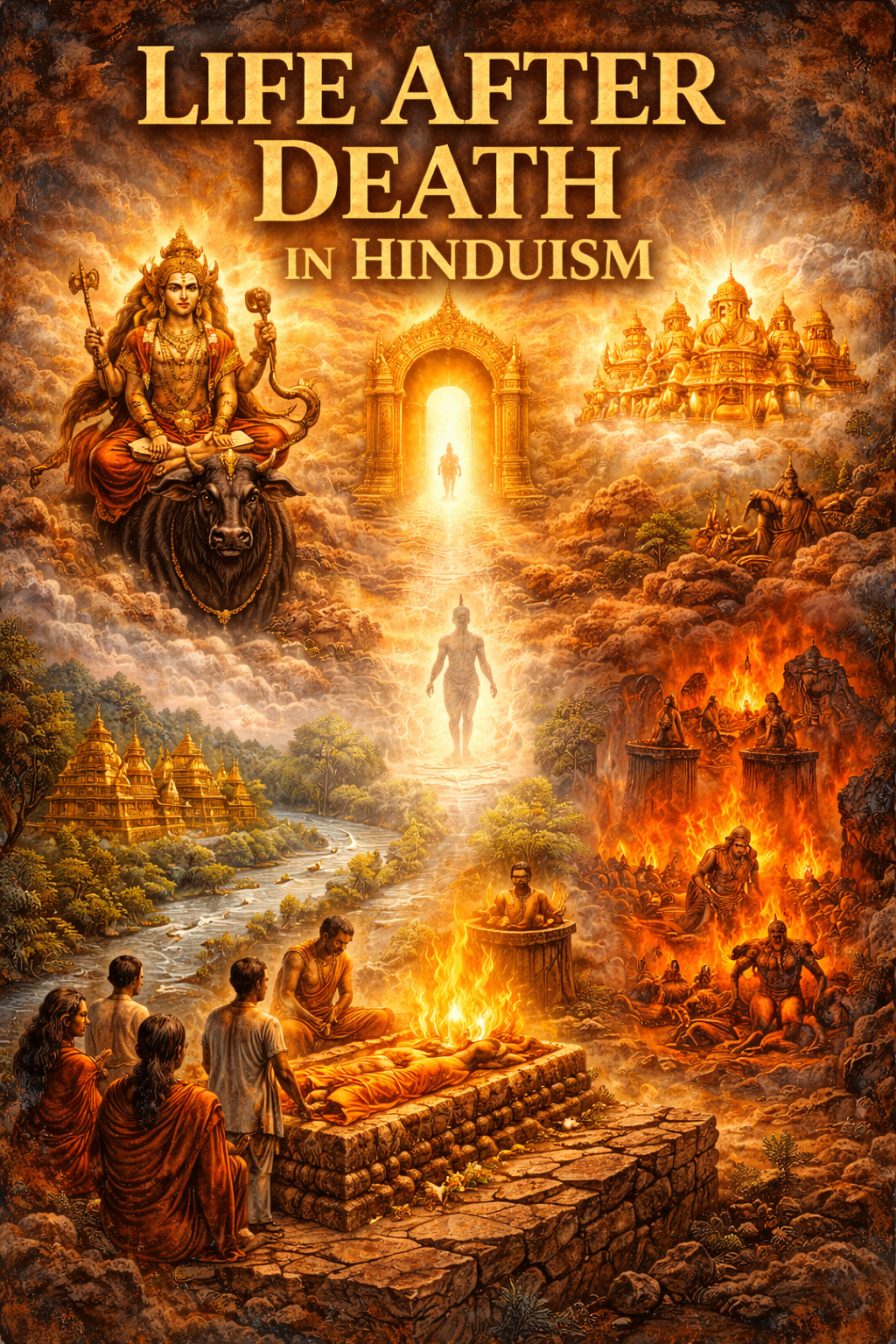
Life After Death in Hinduism

Life After Death in Hinduism — What Really Happens When the Soul Leaves the Body

Introduction Death is the one appointment none of us can cancel. Every human civilisation that has ever existed has tried to understand it — to make peace with it, to explain it, to look it directly in the face without flinching. And across thousands of years of philosophical inquiry, no tradition has examined the question of what happens after death with more depth, more rigour, or more unflinching honesty than Hinduism. Life after death in Hinduism is not a single, simple doctrine. It is a vast, layered, extraordinarily sophisticated understanding of the soul, its journey, and the ultimate nature of existence — one that encompasses reincarnation, karma and rebirth, the subtle body, the various planes of existence, and the final liberation that ends the cycle of birth and death altogether. At Moksh Prapti, we do not approach this subject as theology or consolation. We approach it as the most important philosophical inquiry a human being can undertake — because how you understand death determines, more than almost anything else, how you understand life. मृत्यु जीवन का अंत नहीं है — वह उस यात्रा का एक पड़ाव है जो आत्मा अनंत काल से कर रही है। Death is not the end of life — it is a waystation on a journey the soul has been making since before time began. What Does Hinduism Say About Life After Death Before exploring the specifics, it is important to understand the philosophical foundation on which the Hindu understanding of life after death rests. Hinduism does not believe that you are a body that has a soul. It teaches the precise opposite — that you are a soul, a pure and eternal Consciousness, temporarily inhabiting a body. The body is an instrument. The soul is the musician. When the instrument wears out, the musician does not cease to exist. The musician moves on. This is the bedrock of the Hindu understanding of the soul in Hinduism. Everything else — the karma and rebirth, the subtle planes, the ancestral realms, the final liberation — is built on this single, unshakeable foundation. The Bhagavad Gita states it plainly in the second chapter: Vasamsi jirnani yatha vihaya — just as a person puts on new garments after discarding worn-out ones, the soul accepts new material bodies after casting off the old and useless ones. Death, in the Hindu understanding, is not a full stop. It is a comma. The Journey of the Soul After Death — Step by Step The Moment of Death At the moment of death, the sukshma sharira — the subtle body — separates from the sthula sharira, the gross physical body. The subtle body carries with it the chitta, the accumulated impressions of all thoughts, desires, actions, and karmic residue from the life just lived. The Garuda Purana, one of the primary Hindu scriptural sources on life after death in Hinduism, describes this separation in extraordinary detail — the withdrawal of the senses, the gathering of the vital forces, and the departure of the soul through one of the body’s nine gates, the specific gate depending on the level of consciousness achieved at the moment of death. This is why Hinduism places such profound importance on the state of mind at the moment of dying — and why Hindu rituals surrounding death, the chanting of the divine name, the presence of sacred sounds, and the maintenance of a peaceful environment around the dying person are considered so deeply significant across all Hindu traditions. The Intermediate State — Pitru Loka and Beyond After leaving the body, the soul in Hinduism does not immediately reincarnate. It passes through an intermediate state — described in different texts as Pitru Loka, the realm of the ancestors, or Yamaloka, the realm presided over by Yama, the lord of death and dharma. In this intermediate state, the accumulated karma of the life just completed is processed. The soul experiences the consequences — both pleasant and unpleasant — of its actions from the previous life. The duration of this intermediate state varies according to the karmic weight being carried. The shraddha rituals — among the most important Hindu rituals connected to life after death — performed by surviving family members are not mere sentiment or superstition. The offering of water, sesame seeds, and food to the ancestors is understood in Hindu philosophy as a genuine energetic support to the soul during this transitional phase, an act of love that crosses the boundary between the living and the departed. Karma and Rebirth — The Soul’s Return When the karmic residue of the intermediate state has been fully experienced, the soul returns to the physical plane — taking birth in a new body, in circumstances precisely aligned with the unresolved karma and unfulfilled desires carried forward from previous lives. This is punarjanma — rebirth. And the Hindu understanding of karma and rebirth is not a random lottery. It is a deeply purposeful, intelligently ordered process in which the soul is given, life after life, exactly the experiences it needs to exhaust its accumulated karma and move progressively toward self-knowledge. The form of the next birth — human, animal, or divine — is determined by the dominant tendencies of consciousness at the time of death. This is why the Upanishads and the Gita place such emphasis on the cultivation of sattva — purity, clarity, and wisdom — as the governing quality of one’s inner life. For a deeper understanding of how karma operates across lifetimes and how it shapes every dimension of human experience, read our complete guide on Vedanta Philosophy for Modern Life — a detailed exploration of how the law of conscious cause and effect can be understood and worked with in daily living. The Planes of Existence — Heaven, Hell, and Everything Between Hinduism describes multiple planes of existence — lokas — through which the soul may travel between incarnations. Swarga — often translated as heaven — is not a permanent destination but a temporary realm of refined experience available

Life After Death in Hinduism — What Really Happens When the Soul Leaves the Body Read More »

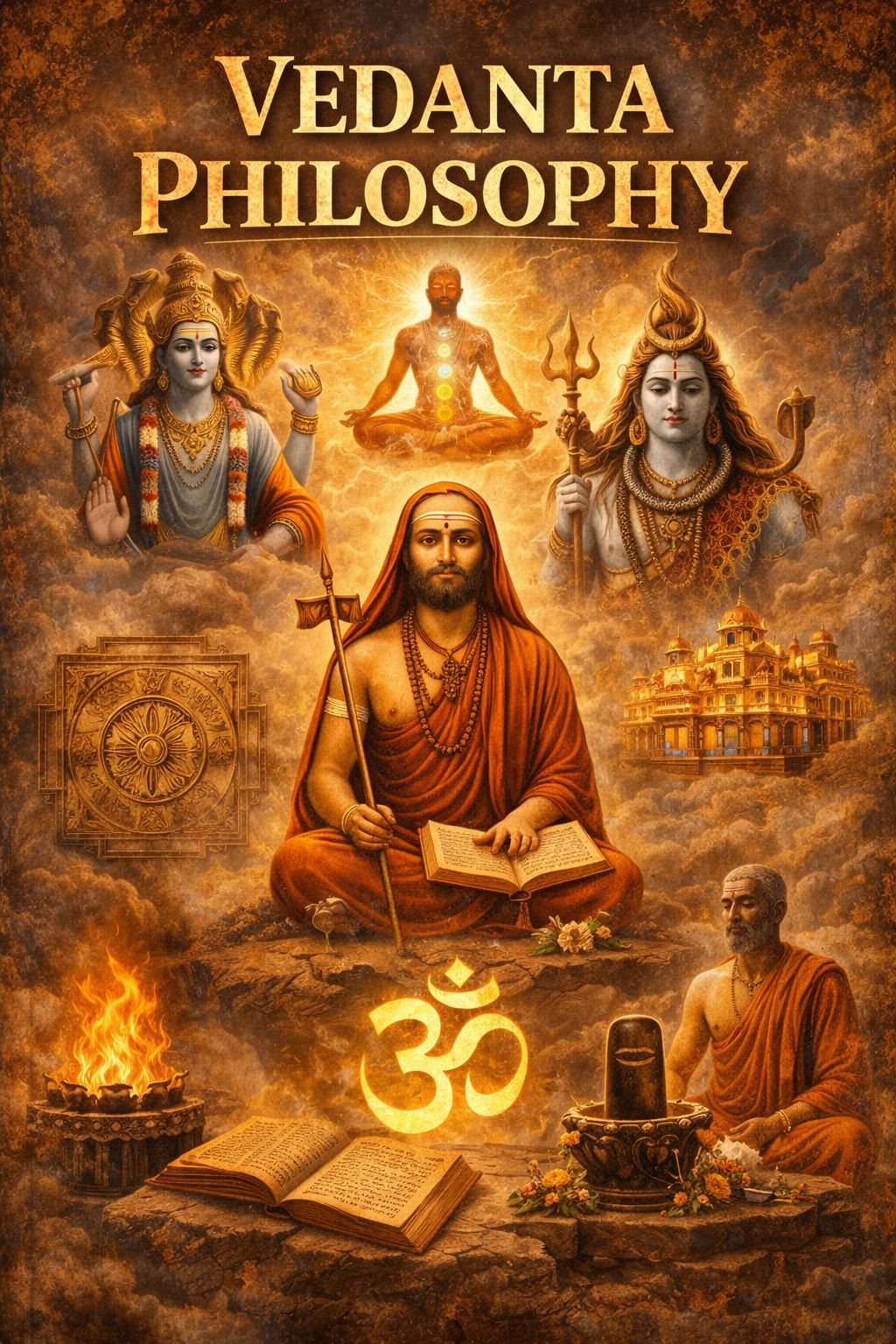
Vedanta Philosophy

5 Vedanta Philosophy — The Most Direct Path to Knowing Who You Are

Introduction There is a question that every human being asks — not once, not occasionally, but persistently, across every season of life, in the quiet spaces between one thought and the next. Who am I? Not your name. Not your profession. Not the story your family told about you or the identity your culture quietly assigned to you before you were old enough to question it. But the one who is asking. The one who has always been asking. The one who was present before the first thought arrived this morning and will still be present after the last thought dissolves tonight. Vedanta philosophy is the most direct, most rigorous, and most complete answer that human civilisation has ever produced to that question. It does not ask you to believe anything on faith. It does not require ritual, renunciation, or the abandonment of your ordinary life. It asks only one thing — that you look. Honestly, carefully, and without flinching — at the nature of your own experience. At Moksh Prapti, Vedanta philosophy is not an academic subject. It is the living centre of everything we do. वेदांत दर्शन वह दर्पण है जिसमें आत्मा अपना असली स्वरूप पहचानती है — न कोई विश्वास चाहिए, न कोई अनुष्ठान — केवल सत्य की खोज। Vedanta philosophy is the mirror in which the soul recognises its true nature — no belief required, no ritual needed — only the search for truth. What Is Vedanta Philosophy — And Why Does It Matter Now Vedanta philosophy is one of the six classical schools of Hindu thought, rooted in the Upanishads, the Bhagavad Gita, and the Brahma Sutras — collectively known as the Prasthanatrayi, the three foundational sources of Vedantic knowledge. The word Vedanta carries the answer within it: Veda means knowledge, anta means end or culmination. Vedanta is therefore the culmination of all knowledge — the point at which intellectual inquiry dissolves into direct understanding of what you fundamentally are. Its central teaching can be stated simply, though its depth is inexhaustible: You are not the body. You are not the mind. You are the eternal, unchanging, self-luminous Consciousness — the Atman — which is not separate from the ultimate reality of the universe — Brahman. Aham Brahmasmi — I am Brahman. Tat Tvam Asi — Thou art That. Prajnanam Brahma — Consciousness is Brahman. Ayam Atma Brahma — This Self is Brahman. These four Mahavakyas — the Great Sayings of the Upanishads — are not poetic metaphors. They are precise philosophical statements about the nature of reality. And Vedanta philosophy is the systematic methodology for moving from intellectual understanding of these statements to direct, lived, unshakeable experience of their truth. In a world drowning in information and starving for wisdom, Vedanta philosophy has never been more urgently needed. 5 Transformative Truths of Vedanta Philosophy for Modern Life You Are Not Your Thoughts — You Are the One Who Watches Them The single most liberating insight Vedanta philosophy offers the modern mind is this: you are not your thoughts. You are the awareness in which thoughts arise, play out, and dissolve — like clouds moving through an open sky. The sky does not become a storm because a storm passes through it. The awareness that you are does not become anxious because an anxious thought arises within it. Modern psychology has taken decades to arrive at a version of this insight — calling it defusion in Acceptance and Commitment Therapy, or decentring in Mindfulness-Based Cognitive Therapy. Vedanta philosophy stated it with complete precision over three thousand years ago. When you begin to identify with the witness rather than the thought, something in your daily experience fundamentally changes. The internal weather still comes and goes. But you are no longer at its mercy. The Self Is Eternal — Fear of Death Is Mistaken Identity The Bhagavad Gita opens with Arjuna in complete psychological collapse — overwhelmed by grief, confusion, and the fear of loss. Krishna’s response, which forms the entire philosophical body of the Gita, begins with a single Vedantic truth: Nainam chhindanti shastrani — weapons cannot cut the Self. Fire cannot burn it, water cannot wet it, wind cannot dry it. The Self was never born and will never die. Vedanta philosophy teaches that the fear of death — which underlies most human anxiety, most compulsive behaviour, most of the grasping and avoidance that makes ordinary life so exhausting — is based on a fundamental misidentification. You have mistaken yourself for the body, which does indeed die. But you are not the body. This is not consolation. This is not wishful thinking. This is the most carefully reasoned, most rigorously examined claim in the entire history of human philosophy — and it is available to be verified, directly, in your own experience. Karma Is Not Punishment — It Is the Law of Conscious Cause and Effect Vedanta philosophy situates karma not as cosmic retribution but as a precise, impersonal law: every action arising from avidya — from ignorance of the true Self — generates a corresponding consequence that must be experienced. Not as punishment. As education. The modern world tends to experience life’s difficulties as either random misfortune or deserved suffering. Vedanta philosophy offers a third understanding — that every experience is an opportunity for the deepening of self-knowledge, that the curriculum of your life has been designed with extraordinary precision to bring you face to face with exactly what you most need to understand. This understanding does not make suffering pleasant. But it makes it meaningful. And meaning, as every serious psychologist since Viktor Frankl has acknowledged, is the most powerful resource a human being possesses. Moksha Is Not Somewhere Else — It Is the Recognition of What You Already Are The goal of Vedanta philosophy is Moksha — liberation. And the most radical thing Vedanta says about liberation is this: it is not something you achieve. It is something you recognise. You are already free. The bondage is not real — it

5 Vedanta Philosophy — The Most Direct Path to Knowing Who You Are Read More »

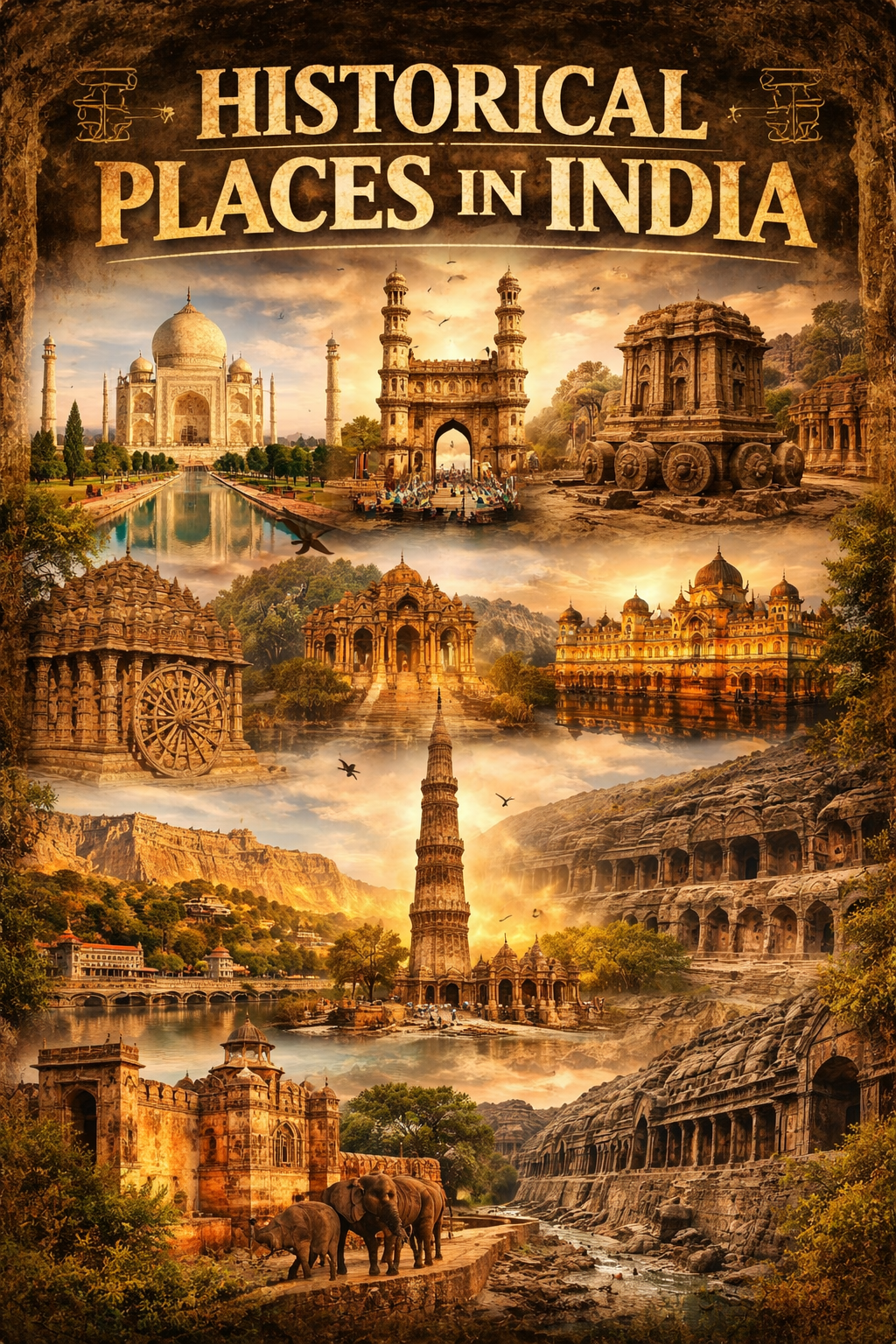
historical places in India

7 Most Breathtaking Historical Places in India That Will Leave You Speechless

Introduction Some places carry the weight of centuries in their stones. You walk through a crumbling archway, run your hand along a wall carved a thousand years ago, and something shifts inside you — not dramatically, not with thunder and revelation, but quietly. A settling. A recognition. As though some part of you has been here before, or has always known that places like this exist, and has been waiting your whole life to finally stand inside one. The historical places in India do this to people. Consistently. Across cultures, across beliefs, across every kind of personal background. They stop you. They slow you down. They remind you — in the most direct and physical way possible — that you are standing inside a story far larger than your own. At Moksh Prapti, we believe that visiting the historical places of India is not an act of looking backward. It is an act of going deeper — into the civilisation that shaped this land, and into the Self that has always been at the centre of it. इतिहास केवल बीता हुआ कल नहीं है — वह वर्तमान की नींव है और आत्मा की पहचान है। History is not merely yesterday — it is the foundation of the present and the recognition of the soul. Why Historical Places in India Are Unlike Anywhere Else on Earth Every ancient civilisation has left behind ruins. Greece has its Parthenon. Egypt has its pyramids. Rome has its Colosseum. These are magnificent. They deserve every word of praise they receive. But the historical places in India carry something that sets them apart from all of these — they are not ruins in the true sense of the word. They are not dead. The temples still receive worshippers at dawn. The ghats still carry the smoke of evening aarti. The forts still echo with the footsteps of the living alongside the memory of the departed. India’s historical places have never stopped breathing — and that continuity, that unbroken thread of living practice running from the ancient world directly into the present day, is what makes them unlike anywhere else on earth. Vedanta understands this continuity not as sentiment but as cosmic truth: Consciousness is unbroken. What was sacred ten thousand years ago remains sacred now. The form changes. The essence does not. वेदांत कहता है — पवित्र स्थान वह है जहाँ चेतना जागृत हो जाए, चाहे वह कितना भी पुराना क्यों न हो। Vedanta says — a sacred place is where Consciousness awakens, however ancient it may be. 7 Most Breathtaking Historical Places in India Every Seeker Must Visit 1️⃣ Hampi, Karnataka — A Kingdom Frozen in Time There is a moment, walking through Hampi at golden hour, when the light falls across the boulder-strewn landscape in such a way that the boundary between past and present simply dissolves. Hampi was the capital of the Vijayanagara Empire — once one of the wealthiest and most powerful kingdoms in the world, home to over half a million people at its peak in the 15th century. Its bazaars stretched for kilometres. Its temples gleamed with gold. Travellers from Persia and Portugal wrote home in disbelief at its magnificence. In 1565, it was sacked and burned over six months by a coalition of Deccan Sultanates. What remains is extraordinary — over 1,600 surviving monuments spread across 41 square kilometres, including the magnificent Virupaksha Temple, which has been in continuous worship for over a thousand years. The ancient temples in India at Hampi are not archaeological exhibits. They are living sacred spaces, still receiving devotees every single morning, within the ruins of a lost empire. 2️⃣ Varanasi, Uttar Pradesh — The Oldest Living City on Earth Varanasi does not belong to history. History belongs to Varanasi. Older than Rome, older than Athens, older than most cities that the Western world considers ancient — Varanasi has been continuously inhabited for at least 3,000 years, and by many scholarly estimates, considerably longer. Mark Twain, visiting in the 19th century, wrote that it was older than history, older than tradition, older even than legend. The historical places in India do not get more layered than this. Every ghat along the Ganges is a palimpsest — centuries of worship, cremation, ritual, and daily life written one on top of the other in an endless, living manuscript. To walk the ghats of Varanasi at dawn is to step directly into the forgotten history of India — not as a visitor to a museum, but as a participant in something that has never stopped. 3️⃣ Ajanta and Ellora Caves, Maharashtra — Art as Spiritual Transmission Cut directly into the volcanic rock of the Sahyadri hills, the Ajanta and Ellora cave complexes represent one of the greatest artistic and spiritual achievements in human history. Ajanta’s 30 caves, carved between the 2nd century BCE and 6th century CE, contain Buddhist murals of such extraordinary refinement that art historians consider them among the finest paintings ever created — anywhere, in any era. The brushwork is fluid, the expressions alive, the narratives drawn from the Jataka tales rendered with a psychological depth that feels startlingly contemporary. Ellora’s 34 caves span three religions — Buddhism, Hinduism, and Jainism — all carved within a single hillside, side by side, in a demonstration of civilisational pluralism that the modern world has yet to fully replicate. The Kailasa Temple at Ellora — carved top-down from a single mountain of rock — remains the largest monolithic rock-cut structure on earth. These are among the most astonishing historical places in India precisely because they reveal a civilisation that understood art not as decoration but as direct spiritual transmission — a carved wall as a portal to awakening. 4️⃣ Fatehpur Sikri, Uttar Pradesh — The City Built on a Blessing Emperor Akbar built Fatehpur Sikri in 1571 in honour of the Sufi saint Sheikh Salim Chishti, who had blessed him with the son he desperately sought. He moved his entire imperial capital here from Agra —

7 Most Breathtaking Historical Places in India That Will Leave You Speechless Read More »

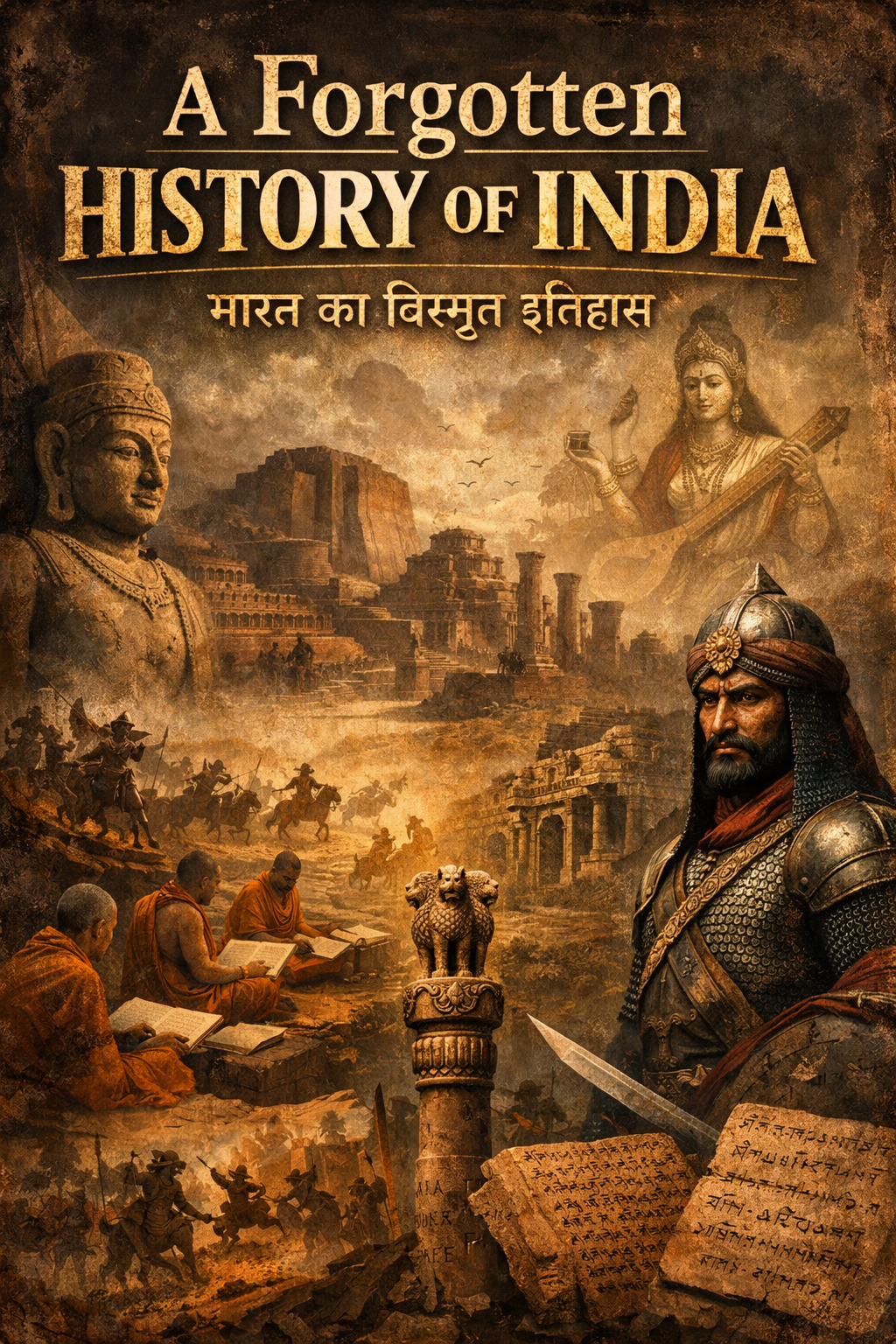
forgotten history of India

🏛️ 7 Forgotten History of India — Ancient Truths That Will Astound You

🪷 Introduction The forgotten history of India is not lost. It is simply waiting. Waiting in the foundations of ancient temples in India that predate recorded civilization. Waiting in mathematical manuscripts that described gravity centuries before Newton. Waiting in cities swallowed by rivers and oceans that archaeologists are only now beginning to uncover. History remembers the loudest voices. The conquerors, the dynasties, the wars that redrew borders and rewrote textbooks. But beneath all of that — older than any of it, quieter than all of it — lies another India entirely. At Moksh Prapti, we believe that history is not merely the past. It is a mirror. And when you look into the forgotten history of India with honest eyes, what looks back at you is a civilisation of staggering depth — one that understood the nature of consciousness, cosmos, and the human soul long before the modern world began asking those questions. वेदांत कहता है — जो भूला हुआ लगता है, वह वास्तव में भीतर ही संरक्षित है। इतिहास केवल बाहर नहीं, आत्मा में भी जीता है। Vedanta says — what appears forgotten is actually preserved within. History lives not only outside, but within the soul. 🕉️ Why the Forgotten History of India Matters Today We live in a civilisation that has developed a very short memory. Anything older than a century feels distant. Anything older than a millennium feels mythological — something to be admired in a museum but not taken seriously as living knowledge. And yet the forgotten history of India keeps insisting otherwise. The ancient temples in India were not merely places of worship — they were universities, observatories, hospitals, and philosophical academies, all contained within a single sacred structure. The gurukul system produced thinkers whose ideas on mathematics, astronomy, medicine, and consciousness have never been fully surpassed. The Indus Valley Civilisation built cities with drainage systems and urban planning that the Western world would not match for another three thousand years. This is not nationalism. This is archaeology. This is documented fact. And still it goes largely untold. Vedanta has a word for this kind of forgetting: Avidya — ignorance not of facts, but of our own deepest nature. The forgotten history of India is, in many ways, a collective Avidya. And recovering it is a collective awakening. 🌿 7 Forgotten Chapters of India’s History That Will Astound You 1️⃣ The Underwater City of Dwarka — Krishna’s Lost Kingdom Off the coast of Gujarat, beneath the waters of the Arabian Sea, lie the submerged ruins of an ancient city. Archaeologists from the Marine Archaeology Unit of India have documented stone walls, pillars, and structural foundations at depths of up to 40 metres — dating back potentially 9,000 to 12,000 years. This is widely believed to be the ancient city of Dwarka — the legendary kingdom of Lord Krishna described in the Mahabharata. For centuries, Dwarka was dismissed as mythology. The ocean floor said otherwise. The ancient temples in India that line the coastline of modern Dwarka are not merely religious sites — they are the visible tip of a civilisation whose full depth is still being revealed, stone by submerged stone. 2️⃣ The Indus Valley Civilisation — The World’s First Urban Culture At its peak around 2500 BCE, the Indus Valley Civilisation was the largest of the ancient world — larger than ancient Egypt and Mesopotamia combined. Its cities of Mohenjo-daro and Harappa had grid-planned streets, two-storey brick houses, public baths, and an advanced sewage system. The forgotten history of India begins here — in a civilisation so sophisticated that modern urban planners study its layouts for lessons. What is most astonishing is what archaeologists have not found: no weapons of mass warfare, no evidence of a ruling military class, no monuments to the glorification of kings. It was, by all available evidence, a remarkably egalitarian society. A civilization that seemed to understand something about collective living that we are still struggling to relearn. 3️⃣ Nalanda University — The World’s First International University Before Oxford. Before Bologna. Before any European university existed, Nalanda stood in present-day Bihar as the greatest centre of learning the ancient world had ever seen. Founded in the 5th century CE, Nalanda hosted over 10,000 students and 2,000 faculty at its height — scholars arriving from China, Korea, Japan, Tibet, Persia, and Greece. Its library, the Dharmaganj, contained three buildings of nine storeys each, housing hundreds of thousands of manuscripts. In 1193 CE, it was burned to the ground by the forces of Bakhtiyar Khilji. Accounts suggest the library burned for three months. The forgotten history of India holds no greater tragedy than Nalanda. And no greater lesson about the fragility of knowledge — and the absolute necessity of preserving it. To understand how the spiritual wisdom taught at Nalanda connects to daily life, read our guide on Vedanta Philosophy Explained for Modern Life — the same consciousness-based understanding that filled those nine-storey libraries is still available to every seeker today. 4️⃣ Aryabhata and the Zero — India’s Gift to All Mathematics In 499 CE, a mathematician and astronomer named Aryabhata wrote a text called the Aryabhatiya. In it, he calculated the value of pi to four decimal places, described the Earth as a sphere rotating on its axis, explained solar and lunar eclipses through geometry, and laid the foundations for algebra and trigonometry. He did all of this a thousand years before Europe reached the same conclusions. The concept of zero — shunya — which makes all modern mathematics, computing, and digital technology possible, originated in India. Without the Indian invention of zero, there is no binary code. There is no computer. There is no internet. There is no smartphone in your hand as you read this. The forgotten history of India is not merely a matter of cultural pride. It is a debt that the entire modern world carries. 5️⃣ The Ancient Temples of India as Living Universities The ancient temples in India have always been more than

🏛️ 7 Forgotten History of India — Ancient Truths That Will Astound You Read More »

mysterious places in India

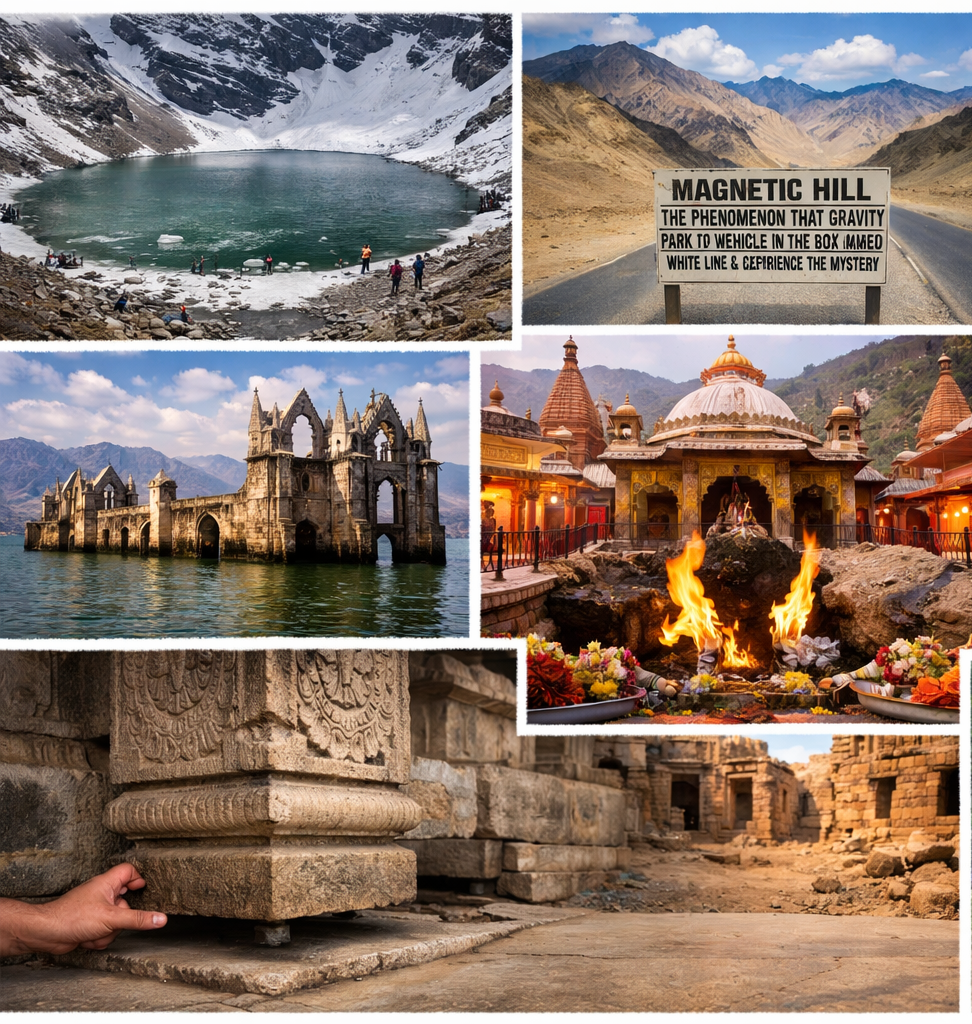
7 Most Mysterious Places in India That Will Shock You | Moksh Prapti

Introduction India has always held secrets. Not the kind hidden in locked rooms or buried in archives — but the kind that live in the open air, in the middle of ancient forests and forgotten valleys and temples so old that no one can say with certainty who built them or why. The kind of secrets that do not hide from you. They wait for you. The mysterious places in India are not curiosities for the casual traveller. They are invitations — extended across centuries — to the seeker who is ready to ask deeper questions. Questions not just about history or science, but about the nature of reality itself. At Moksh Prapti, we believe that mystery is not the opposite of knowledge. Mystery is where true knowledge begins. Why Mysterious Places in India Still Shake the Modern Mind We live in an era that believes it has explained everything. Science has mapped the genome, landed machines on Mars, and modelled the birth of galaxies. And yet — India keeps offering up places that refuse to be explained. Places that sit outside the neat edges of what we think we know. The mysterious places in India are not accidents of folklore. Many of them have been studied, measured, investigated. And still they remain — inexplicable, undeniable, and profoundly alive. Vedanta has never been afraid of mystery. In fact, it begins there. The deepest Vedantic teaching — Neti, Neti, “not this, not this” — is itself an acknowledgement that reality is always larger than our current understanding of it. जो अज्ञात है, वह भय नहीं — वह आमंत्रण है। रहस्य वह द्वार है जिससे सत्य की झलक मिलती है। What is unknown is not fear — it is an invitation. Mystery is the doorway through which truth is glimpsed. 7 Mysterious Places in India That Will Unsettle and Awaken You 1️⃣ Roopkund Lake, Uttarakhand — The Lake of Skeletons High in the Himalayas, at an altitude of over 5,000 metres, lies a small glacial lake with a secret that has disturbed researchers for decades. At the bottom of Roopkund — and scattered along its frozen shores — lie the skeletal remains of hundreds of human beings. DNA analysis has traced the bones to multiple time periods and even to individuals from the Mediterranean, thousands of miles away. What were they doing here? How did they die? Why do they keep returning to the surface as the ice melts each summer? Science has offered theories. None has fully satisfied. And perhaps that is the point. Some mysteries are not meant to be solved. They are meant to be sat with — and in that sitting, something in us grows humble. 2️⃣ Magnetic Hill, Ladakh — Where Gravity Seems to Reverse On the Leh-Kargil highway, there is a stretch of road that does the impossible: vehicles placed in neutral roll uphill. On their own. Against gravity. Or so it appears. Scientists have explained it as a gravitational anomaly, an optical illusion created by the surrounding landscape. But even knowing that, standing there and watching a car roll the wrong way up a hill does something to the certainty in your chest. It loosens it, just a little. The mysterious places in India often work this way. They do not demand belief. They simply demonstrate — quietly, repeatedly — that the world is not quite what we assumed it to be. 3️⃣ Kuldhara Village, Rajasthan — Abandoned in a Single Night In 1825, the entire population of Kuldhara — nearly 1,500 people across 84 villages — vanished overnight. No bodies. No struggle. No record of where they went. They left behind only a curse: that no one would ever successfully inhabit this land again. Two centuries later, Kuldhara remains empty. Its stone houses stand intact. Its streets are swept by wind and silence. The government has attempted resettlement. No one has stayed. Historians offer explanations involving political oppression. But the locals — and many of the investigators who have visited after dark — speak of something else entirely. A presence. A weight in the air. A feeling of being watched by something that left long ago but did not fully leave. 4️⃣ Shettihalli Church, Karnataka — The Church That Drowns Every Year The Rosary Church of Shettihalli was built by French missionaries in the 19th century. In 1964, the construction of the Hemavathi reservoir submerged the surrounding village. The church was abandoned. Every monsoon, the rising waters swallow it completely. Every summer, it re-emerges — roofless, Gothic arches intact, draped in moss and memory, rising from the receding water like something from a dream. It is one of the most quietly haunting of all mysterious places in India. Not because of any supernatural claim. But because of what it makes you feel: the relentless passage of time, the fragility of everything we build, and the strange, stubborn beauty of what remains. 5️⃣ Jwala Ji Temple, Himachal Pradesh — The Flame That Never Goes Out In the Kangra Valley of Himachal Pradesh, within a cave in the earth, nine flames burn continuously from natural vents in the rock. No oil. No fuel. No external source that anyone has been able to identify. They have been burning — according to local record — for as long as human memory reaches. Emperor Akbar, the Mughal ruler, was reportedly so unsettled by them that he attempted to extinguish them with water channelled from a nearby stream. The flames did not go out. Jwala Ji is one of the 51 Shakti Peethas — sites of the most concentrated divine feminine energy in the subcontinent. Vedanta understands Shakti not as supernatural intervention but as the primordial energy of Consciousness itself. These flames, in that understanding, are not a miracle. They are a reminder. 6️⃣ Kodinhi, Kerala — The Village of Twins The global average for twin births is approximately 4 per 1,000 deliveries. In Kodinhi, a small village in Kerala, the rate is over 45 per 1,000 — more

7 Most Mysterious Places in India That Will Shock You | Moksh Prapti Read More »

ancient temples in India

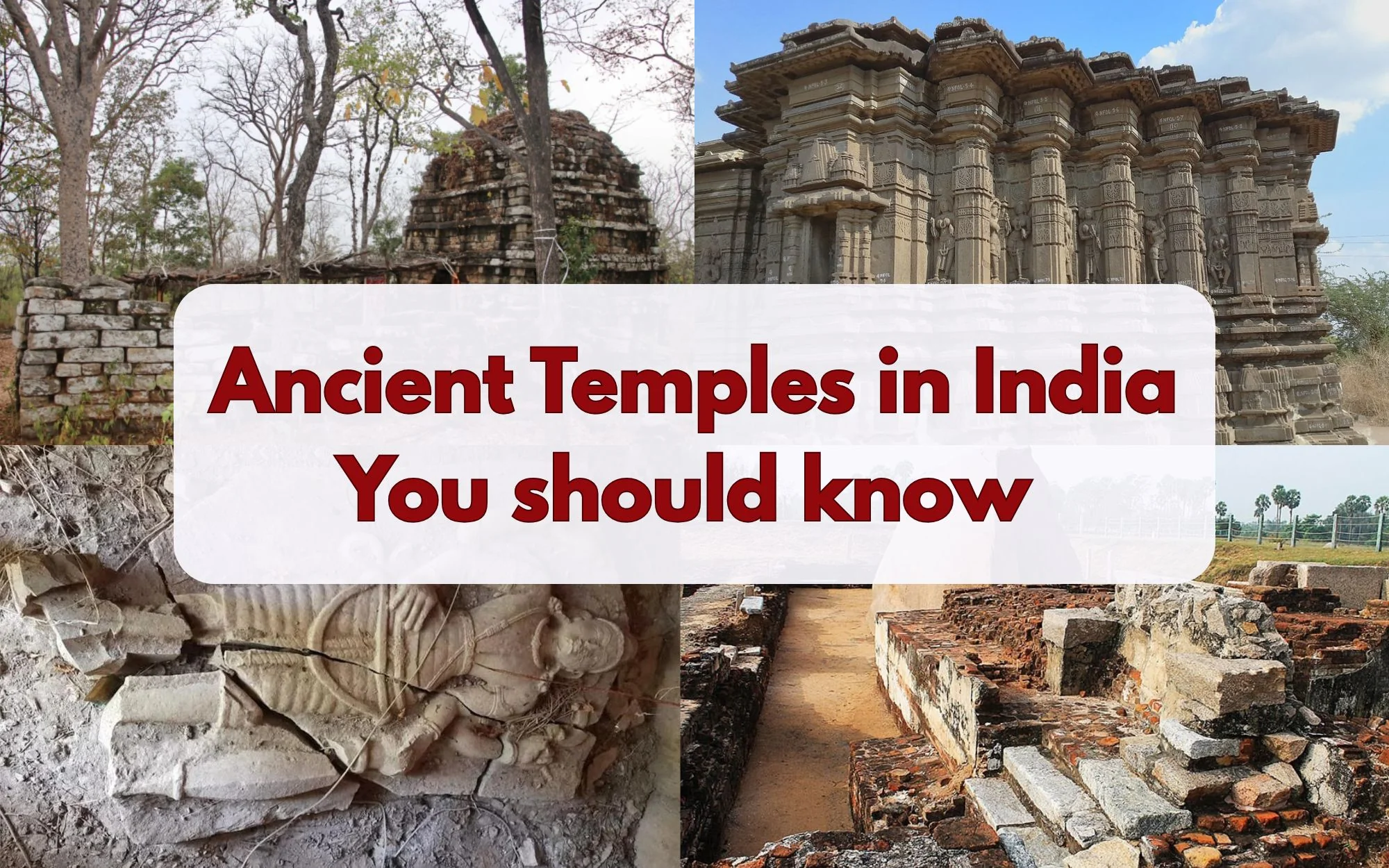
🛕 Ancient Temples in India — A Journey Into the Soul of Civilization

By Moksh Prapti | Category: Temples, Spirituality & Sacred Travel 🪷 Introduction India is not just a country — it is a living, breathing civilisation that has been praying, meditating, and seeking the divine for thousands of years. And nowhere is this more visible than in its ancient temples. The ancient temples in India are not merely architectural marvels. They are energy centres, philosophical texts carved in stone, and portals to a deeper understanding of life, consciousness, and the eternal Self. Whether you stand before the towering gopuram of a South Indian temple or walk the ghats of Varanasi at dawn, something shifts inside you — something ancient stirs awake. At Moksh Prapti, we believe that visiting these sacred spaces is not just tourism. It is a step on the path toward liberation. 🕉️ Why Ancient Temples in India Still Matter Today We live in an age of speed. Notifications, deadlines, social media — the modern mind rarely gets a moment of stillness. Yet millions of people across the world are now turning toward India’s ancient temples, not out of religious obligation, but out of a deep inner hunger for meaning and peace. These temples were built by sages and kings who understood something we are only beginning to rediscover — that architecture itself can be a spiritual tool. The proportions, the geometry, the chants echoing off stone walls — all of it was designed with one purpose in mind: to help a human being go inward. वेदांत कहता है कि जब बाहर की यात्रा भीतर की यात्रा बन जाए, तभी तीर्थ सार्थक होता है। 🌿 7 Ancient Temples in India That Will Transform You Within 1️⃣ Kashi Vishwanath Temple, Varanasi — Where Time Dissolves Varanasi is perhaps the oldest living city in the world, and Kashi Vishwanath stands at its very heart. Dedicated to Lord Shiva, this temple has been a centre of spiritual learning and liberation for millennia. The Vedantic teaching of Tattvamasi — “Thou art That” — finds its most potent expression here, where life and death dance together on the ghats every single day. Visiting Kashi is not just a religious act. It is a confrontation with impermanence — and in that confrontation, true freedom begins. 2️⃣ Brihadeeswarar Temple, Thanjavur — A Stone Symphony of Consciousness Built by Raja Raja Chola I in the 11th century, the Brihadeeswarar Temple in Tamil Nadu is an engineering wonder that no modern machine fully understands. The massive shadow of its vimana (tower) never falls on the ground — a detail that still puzzles architects today. This temple is dedicated to Shiva as the cosmic dancer, Nataraja — a metaphor Vedanta uses beautifully to explain how the universe itself is the dance of pure consciousness. Standing here, one begins to feel that life is not a problem to be solved, but a rhythm to be felt. 3️⃣ Konark Sun Temple, Odisha — Time, Light, and the Eternal Now The Konark Sun Temple is built in the shape of a massive chariot drawn by seven horses — representing the seven days of the week and the eternal movement of time. Every wall, every wheel, every sculpture is a lesson in cosmology and human experience. Vedanta teaches that the body is a chariot, the intellect the charioteer, and the Self the silent passenger. Konark makes this philosophy visible, tangible, and breathtakingly beautiful. 4️⃣ Meenakshi Amman Temple, Madurai — The Divine Feminine Awakens With its fourteen colorful gopurams and over 33,000 sculptures, the Meenakshi Temple in Madurai is a universe unto itself. Dedicated to Goddess Meenakshi — a form of Parvati — this temple celebrates Shakti, the primal feminine energy that underlies all creation. In Vedantic understanding, the universe is not matter — it is consciousness in expression. The Meenakshi Temple brings this alive not through words, but through the sheer overwhelming beauty of the sacred feminine. 5️⃣ Kedarnath Temple, Uttarakhand — Silence at 3,583 Metres Perched high in the Himalayas, the Kedarnath Temple is not for the faint of heart — and that is exactly the point. The journey itself is the teaching. Every difficult step upward becomes a meditation on surrender, effort, and grace. Dedicated to Lord Shiva, Kedarnath strips away the unnecessary. The cold, the altitude, the raw silence of the mountains — all of it conspires to bring you face to face with yourself. This is Vedanta not read in a book, but lived in the body. 6️⃣ Somnath Temple, Gujarat — Rebuilt Seven Times, Still Standing Perhaps no temple in India carries as much history — or as much resilience — as Somnath. Destroyed and rebuilt seven times over centuries, Somnath is a testament to the unbreakable spirit of a civilisation rooted in dharma. The teaching here is Vedantic at its core: the body may fall, structures may crumble, but the Self — like Somnath — always rises again. You cannot destroy what is eternal. 7️⃣ Tirupati Balaji Temple, Andhra Pradesh — Devotion Beyond Reason The Tirumala Venkateswara Temple at Tirupati is the most visited place of worship on earth. Millions arrive every year — not because they are told to, but because something in them simply pulls them there. Devotion, Vedanta teaches, is not weakness. Bhakti is one of the most powerful paths to self-realization. When the heart opens completely in love and surrender, the ego dissolves naturally — and what remains is pure awareness. 🔥 What Ancient Temples in India Teach Us About Life Every ancient temple in India is a textbook of Vedantic wisdom expressed in stone, ritual, and sacred geometry. Together, they teach: 🧘 How Moksh Prapti Guides You on This Journey At Moksh Prapti, our purpose is simple — to help modern seekers find their way back to themselves. The ancient temples in India are not relics of the past. They are living invitations to wake up, to go deeper, and to remember who you truly are. Whether you are drawn to the Vedantic philosophy of non-duality, the devotional path of Bhakti,

🛕 Ancient Temples in India — A Journey Into the Soul of Civilization Read More »

प्रमुख विश्व धर्मों की उत्पत्ति: 6 प्रमुख धर्मों का रहस्यमय और प्रेरणादायक इतिहास

प्रमुख विश्व धर्मों की उत्पत्ति मानव सभ्यता के इतिहास का एक रहस्यमय और प्रेरणादायक अध्याय है। प्रमुख विश्व धर्मों की उत्पत्ति को समझना हमें यह जानने में मदद करता है कि अलग-अलग समय, स्थान और सामाजिक परिस्थितियों में धर्मों ने मानव जीवन को किस प्रकार दिशा दी। आज जिन 6 प्रमुख धर्मों को हम विश्व स्तर पर मान्यता प्राप्त रूप में देखते हैं, उनकी ऐतिहासिक जड़ें गहरी आध्यात्मिक खोज और मानवीय मूल्यों से जुड़ी हुई हैं। इस लेख में हम प्रमुख विश्व धर्मों की उत्पत्ति को सरल भाषा में समझेंगे और जानेंगे कि कैसे ये धर्म आज भी करोड़ों लोगों के जीवन को प्रेरित कर रहे हैं। इस लेख में हम प्रमुख विश्व धर्मों की उत्पत्ति को सरल, ऐतिहासिक और तथ्यात्मक रूप में समझेंगे, ताकि हर पाठक इसे आसानी से समझ सके। 🌍 धर्म का अर्थ और ऐतिहासिक भूमिका धर्म का अर्थ केवल पूजा-पाठ या धार्मिक अनुष्ठानों तक सीमित नहीं है। धर्म मानव को सत्य, करुणा, अनुशासन और नैतिक जीवन का मार्ग दिखाता है। इतिहास में जब मनुष्य प्राकृतिक शक्तियों और जीवन के रहस्यों को समझने में असमर्थ था, तब धर्म ने उसे मानसिक शांति और सामाजिक एकता प्रदान की। इसी प्रक्रिया के दौरान प्रमुख विश्व धर्मों की उत्पत्ति हुई। 🕉️ हिंदू धर्म की उत्पत्ति हिंदू धर्म को विश्व का सबसे प्राचीन धर्म माना जाता है। इसकी उत्पत्ति लगभग 3000 से 1500 ईसा पूर्व वैदिक काल में मानी जाती है। हिंदू धर्म की विशेषता यह है कि यह समय के साथ विकसित होता रहा और इसी कारण यह आज भी जीवंत है। प्रमुख विश्व धर्मों की उत्पत्ति में हिंदू धर्म की भूमिका सबसे प्राचीन मानी जाती है। ☸️ बौद्ध धर्म की उत्पत्ति बौद्ध धर्म की स्थापना महात्मा गौतम बुद्ध ने लगभग 6वीं शताब्दी ईसा पूर्व भारत में की। बौद्ध धर्म भारत से एशिया के कई देशों में फैला और वहां की संस्कृति को गहराई से प्रभावित किया। 🕊️ जैन धर्म की उत्पत्ति जैन धर्म की उत्पत्ति भी भारत में हुई। इसके 24वें और अंतिम तीर्थंकर महावीर स्वामी माने जाते हैं। प्रमुख विश्व धर्मों की उत्पत्ति के अध्ययन में जैन धर्म का योगदान नैतिक मूल्यों के कारण अत्यंत महत्वपूर्ण है। ✝️ ईसाई धर्म की उत्पत्ति ईसाई धर्म की उत्पत्ति यीशु मसीह की शिक्षाओं से हुई। इसका आरंभ लगभग 1वीं शताब्दी ईस्वी में मध्य-पूर्व क्षेत्र में हुआ। आज ईसाई धर्म विश्व का सबसे बड़ा धर्म है और इसका प्रभाव शिक्षा, सेवा और मानवाधिकारों में स्पष्ट दिखाई देता है। ☪️ इस्लाम धर्म की उत्पत्ति इस्लाम धर्म की स्थापना पैगंबर मुहम्मद साहब ने 7वीं शताब्दी ईस्वी में अरब में की। इस्लाम ने समानता, अनुशासन और सामाजिक न्याय पर विशेष बल दिया। प्रमुख विश्व धर्मों की उत्पत्ति में इस्लाम का योगदान वैश्विक स्तर पर अत्यंत प्रभावशाली रहा है। ✡️ यहूदी धर्म की उत्पत्ति यहूदी धर्म को सबसे प्राचीन एकेश्वरवादी धर्मों में से एक माना जाता है। यहूदी धर्म से ही ईसाई और इस्लाम धर्म का ऐतिहासिक विकास हुआ। 🌐 प्रमुख विश्व धर्मों की उत्पत्ति का महत्व इतिहासकारों के अनुसार, प्रमुख विश्व धर्मों की उत्पत्ति मानव समाज की आध्यात्मिक और सामाजिक आवश्यकताओं से जुड़ी हुई है। धर्मों ने: आज के समय में भी धर्म शांति, सहिष्णुता और मानवता का संदेश देते हैं। ✨ निष्कर्ष निष्कर्ष रूप में कहा जा सकता है कि प्रमुख विश्व धर्मों की उत्पत्ति मानव इतिहास का वह अध्याय है जिसने सभ्यता को दिशा दी। विभिन्न धर्म अलग-अलग समय और स्थान पर उत्पन्न हुए, लेकिन उनका उद्देश्य मानव को नैतिक, आध्यात्मिक और संतुलित जीवन की ओर ले जाना था। प्रमुख विश्व धर्मों की उत्पत्ति को समझना हमें आपसी सम्मान, सह-अस्तित्व और वैश्विक शांति का महत्व सिखाता है।

प्रमुख विश्व धर्मों की उत्पत्ति: 6 प्रमुख धर्मों का रहस्यमय और प्रेरणादायक इतिहास Read More »

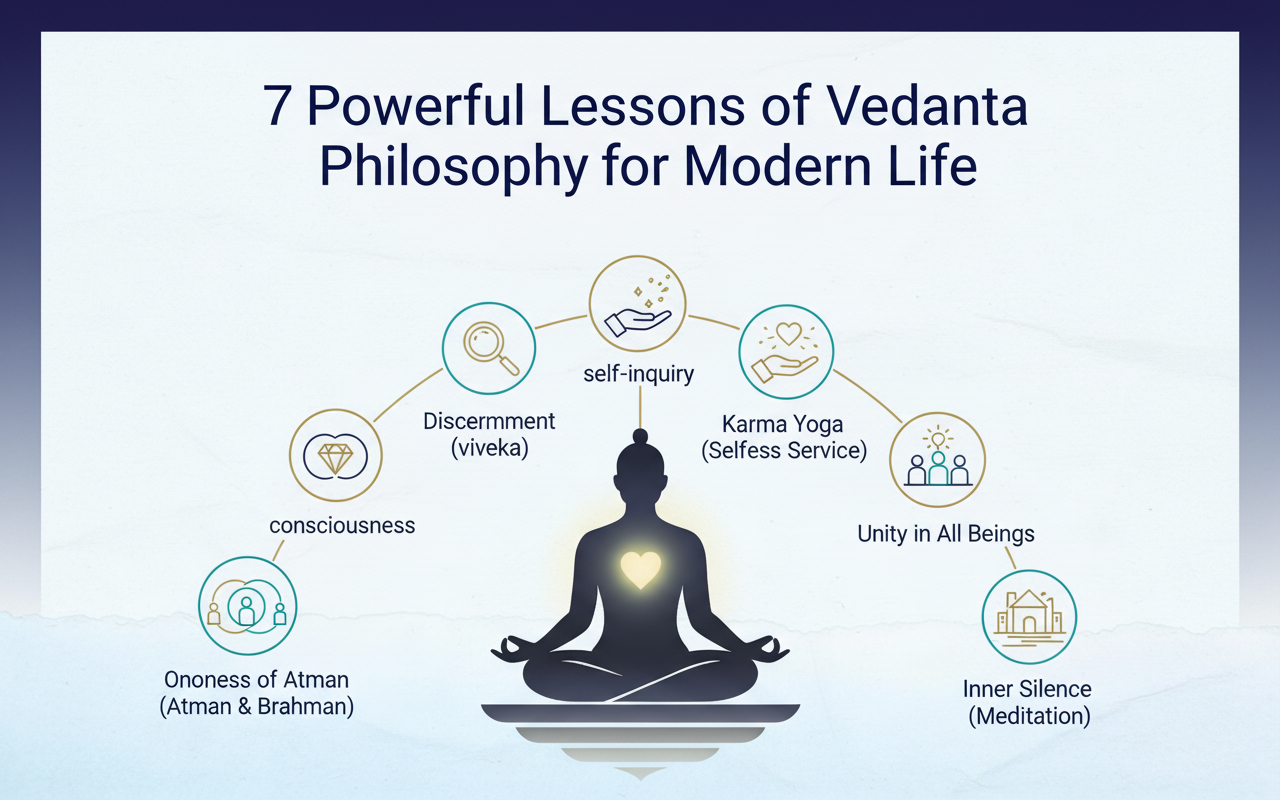
7 Powerful Lessons of Vedanta Philosophy for Modern Life

7 Powerful Lessons of Vedanta Philosophy for Modern Life

🌸 Vedanta Philosophy Explained for Modern Life 🪷 Introduction Vedanta philosophy for modern life offers timeless wisdom to address today’s stress, confusion, and emotional imbalance. In an age of constant competition, digital overload, and material pursuit, many people feel disconnected from inner peace. Vedanta reminds us that true fulfillment does not come from the outside world but from understanding our inner reality. वेदांत दर्शन आधुनिक जीवन के लिए एक ऐसा मार्ग है जो बाहरी भागदौड़ के बीच भी शांति और स्पष्टता प्रदान करता है। 🕉️ What Is Vedanta Philosophy? (H2) Vedanta is one of the most profound schools of Hindu philosophy, rooted in the Upanishads, Bhagavad Gita, and Brahma Sutras. The word Vedanta means “the end of the Vedas,” signifying the ultimate knowledge of existence. The core teaching of Vedanta is simple yet powerful: This understanding forms the foundation of Vedanta philosophy for modern life. 🌿 Why Vedanta Philosophy Is Relevant Today (H2) Modern society has achieved material success but often lacks inner contentment. Anxiety, depression, and fear have become common despite comfort and convenience. Vedanta philosophy for modern life addresses this imbalance by shifting focus inward. Vedanta teaches: वेदांत हमें सिखाता है कि बाहरी परिस्थितियाँ नहीं, बल्कि हमारी समझ ही हमारे दुख और सुख का कारण है। 🌞 7 Powerful Lessons of Vedanta Philosophy for Modern Life (H2) 1️⃣ You Are Not Your Thoughts (H3) Vedanta explains that thoughts come and go, but the observer remains unchanged. Recognizing this reduces stress and emotional reactivity. 2️⃣ True Happiness Comes from Within (H3) External achievements provide temporary joy, while inner awareness offers lasting peace. 3️⃣ Detachment Brings Freedom (H3) Vedanta encourages performing duties without attachment to outcomes, reducing anxiety and disappointment. 4️⃣ Ego Is the Root of Suffering (H3) The ego creates separation and fear. Vedanta dissolves ego through self-knowledge. 5️⃣ Meditation Is Essential (H3) Meditation quiets the mind and allows direct experience of the Self, making Vedanta practical for daily life. 6️⃣ Service Purifies the Mind (H3) Selfless service (Seva) reduces ego and strengthens compassion. 7️⃣ Awareness Transforms Everyday Life (H3) Living consciously turns ordinary activities into spiritual practice. 🔥 Vedanta, Karma, and Life’s Challenges (H2) Vedanta teaches that life’s challenges are shaped by karma, not punishment. By understanding karma, one responds with wisdom instead of resistance. This outlook helps modern individuals face difficulties with acceptance and strength. Vedanta encourages learning from experiences rather than escaping them. 🧘 Vedanta and Moksha: The Ultimate Goal (H2) The ultimate aim of Vedanta is Moksha, liberation from ignorance and suffering. Moksha is not achieved by abandoning life but by understanding it deeply. To explore the spiritual journey after death, read our guide on Life After Death in Hinduism. According to the Bhagavad Gita on Self-Knowledge, the Self is eternal and unaffected by change. 🌺 Applying Vedanta Philosophy in Daily Life (H2) Vedanta philosophy for modern life can be practiced by: वेदांत जीवन से भागने का नहीं, बल्कि उसे सही दृष्टि से जीने का मार्ग है। 🌈 Conclusion Vedanta philosophy for modern life bridges ancient wisdom and contemporary living. It teaches that peace is not something to be achieved in the future—it is your true nature here and now. By applying Vedantic principles, one can live with clarity, balance, and spiritual fulfillment even in the midst of modern challenges. वेदांत हमें जीवन को समझने की दृष्टि देता है, जिससे जीवन स्वयं साधना बन जाता है। 📌 Author & SEO Info Author: Sandeep KumarCategory: Vedanta & Consciousness SEO Keywords Used Naturally:Vedanta philosophy, modern spirituality, self-realization, consciousness, meditation, Moksha, awareness Vedanta philosophy for modern life becomes truly practical when inner awareness is awakened alongside daily responsibilities. For readers seeking a deeper experiential understanding, our guide on 7 Powerful Truths of Modern Self-Awakening through Vedanta explains how Vedantic wisdom can be applied step by step to cultivate clarity, peace, and self-realization in everyday modern living.

7 Powerful Lessons of Vedanta Philosophy for Modern Life Read More »

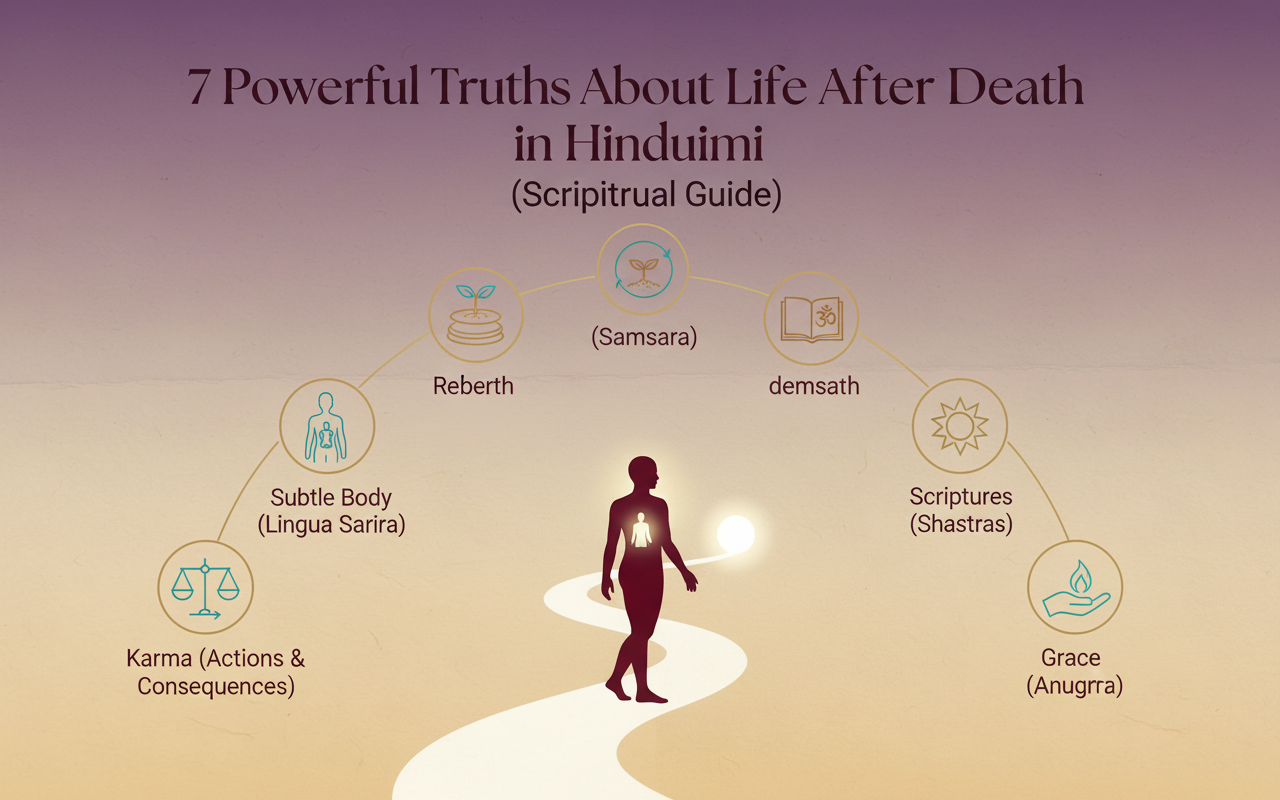
7 Powerful Truths About Life After Death in Hinduism (Scriptural Guide)

7 Powerful Truths About Life After Death in Hinduism (Scriptural Guide)

Life After Death in Hinduism: Soul Journey According to Scriptures Introduction Life after death in Hinduism is not a mystery filled with fear, but a deeply spiritual and well-structured journey explained in ancient scriptures. Hindu philosophy teaches that death is not the end of existence—it is merely the transition of the soul (Atma) from one form to another. Many people seek answers about what happens after death, especially during times of loss. Understanding life after death in Hinduism brings clarity, peace, and acceptance by revealing the eternal nature of the soul. Is There Life After Death in Hinduism? According to Hindu scriptures, the soul is: The body perishes, but the soul continues its journey based on karma and spiritual awareness. भगवद गीता में स्पष्ट कहा गया है —“आत्मा न जन्म लेती है, न मरती है।” The Soul’s Journey After Death in Hinduism The journey of the soul after death follows a divine law governed by karma. 🔹 Separation from the Body At death, the soul leaves the physical body. Consciousness withdraws, and the soul carries subtle impressions (sanskaras) from past actions. 🔹 Role of Karma Good and bad deeds determine the soul’s next destination: This karmic balance decides life after death in Hinduism. Role of Funeral Rituals in the Soul’s Journey Hinduism emphasizes proper death rituals to support the soul’s peaceful transition. Sacred rites such as Hindu Antyeshti rituals help: Improper or incomplete rites are believed to delay the soul’s journey. Scriptural Views on Life After Death in Hinduism 🔹 Bhagavad Gita The Gita explains that the soul changes bodies just as a person changes clothes. Scriptural reference:Bhagavad Gita on the Eternal Soul 🔹 Garuda Purana The Garuda Purana describes: It gives a detailed map of life after death in Hinduism. 🔹 Upanishads Upanishads teach that realization of the Self leads to freedom from rebirth. Rebirth vs Moksha: Two Paths After Death After death, the soul follows one of two paths: Rebirth If desires and karmas remain: Moksha If ignorance dissolves: Learn more in our detailed guide on Moksha in Hinduism. Can the Living Help the Soul After Death? Yes. Hinduism teaches that family members can assist the soul through: These acts generate positive spiritual energy and peace for the departed soul. Why Understanding Life After Death in Hinduism Matters Knowing the truth about death: जीवन और मृत्यु दोनों को समझना ही सच्ची बुद्धि है। Conclusion Life after death in Hinduism is a continuation of the soul’s sacred journey, guided by karma, awareness, and divine law. Death is not an end but a doorway to transformation. When this truth is understood, life becomes meaningful, conscious, and spiritually aligned. मृत्यु अंत नहीं, बल्कि आत्मा की यात्रा का एक चरण है। 📌 Author & SEO Info Author: Sandeep KumarCategory: Soul Journey & Moksha SEO Keywords Used Naturally:Soul after death, rebirth in Hinduism, karma and rebirth, Moksha, Garuda Purana, Hindu beliefs on death Hindu scriptures explain that the soul’s journey does not end with death but continues according to karma and spiritual awareness. For a deeper understanding of this journey, read our detailed guide on 7 Ultimate Truths About Moksha in Hinduism & Spiritual Liberation, which explains rebirth, Moksha, and the soul’s path after leaving the body. Ancient texts like the Bhagavad Gita on the Eternal Soul clearly state that the soul changes bodies just as a person changes clothes, reinforcing the Hindu belief in life beyond physical death.

7 Powerful Truths About Life After Death in Hinduism (Scriptural Guide) Read More »

Scroll to Top