

Introduction
India has always held secrets.
Not the kind hidden in locked rooms or buried in archives — but the kind that live in the open air, in the middle of ancient forests and forgotten valleys and temples so old that no one can say with certainty who built them or why. The kind of secrets that do not hide from you. They wait for you.
The mysterious places in India are not curiosities for the casual traveller. They are invitations — extended across centuries — to the seeker who is ready to ask deeper questions. Questions not just about history or science, but about the nature of reality itself.
At Moksh Prapti, we believe that mystery is not the opposite of knowledge. Mystery is where true knowledge begins.
Why Mysterious Places in India Still Shake the Modern Mind
We live in an era that believes it has explained everything. Science has mapped the genome, landed machines on Mars, and modelled the birth of galaxies. And yet — India keeps offering up places that refuse to be explained. Places that sit outside the neat edges of what we think we know.
The mysterious places in India are not accidents of folklore. Many of them have been studied, measured, investigated. And still they remain — inexplicable, undeniable, and profoundly alive.
Vedanta has never been afraid of mystery. In fact, it begins there. The deepest Vedantic teaching — Neti, Neti, “not this, not this” — is itself an acknowledgement that reality is always larger than our current understanding of it.
जो अज्ञात है, वह भय नहीं — वह आमंत्रण है। रहस्य वह द्वार है जिससे सत्य की झलक मिलती है।
What is unknown is not fear — it is an invitation. Mystery is the doorway through which truth is glimpsed.
7 Mysterious Places in India That Will Unsettle and Awaken You
1️⃣ Roopkund Lake, Uttarakhand — The Lake of Skeletons
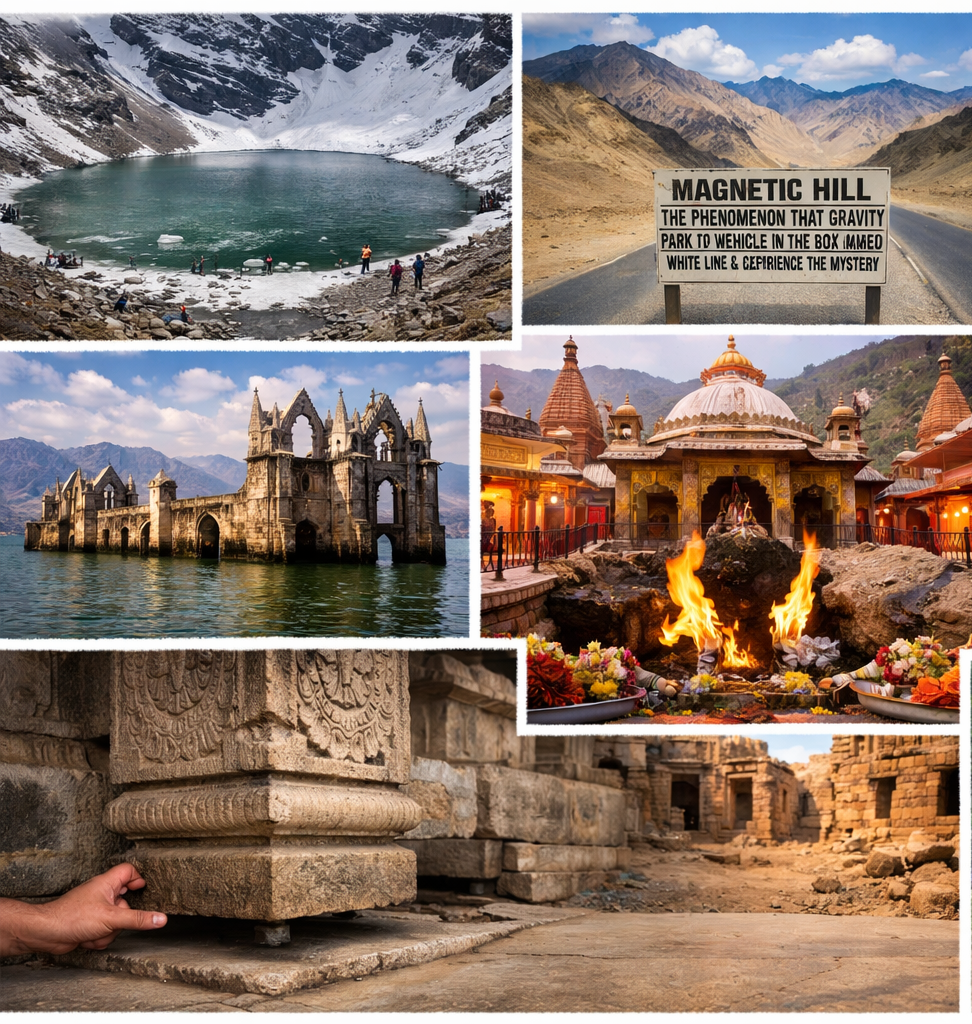
High in the Himalayas, at an altitude of over 5,000 metres, lies a small glacial lake with a secret that has disturbed researchers for decades. At the bottom of Roopkund — and scattered along its frozen shores — lie the skeletal remains of hundreds of human beings.
DNA analysis has traced the bones to multiple time periods and even to individuals from the Mediterranean, thousands of miles away. What were they doing here? How did they die? Why do they keep returning to the surface as the ice melts each summer?
Science has offered theories. None has fully satisfied. And perhaps that is the point. Some mysteries are not meant to be solved. They are meant to be sat with — and in that sitting, something in us grows humble.
2️⃣ Magnetic Hill, Ladakh — Where Gravity Seems to Reverse
On the Leh-Kargil highway, there is a stretch of road that does the impossible: vehicles placed in neutral roll uphill. On their own. Against gravity. Or so it appears.
Scientists have explained it as a gravitational anomaly, an optical illusion created by the surrounding landscape. But even knowing that, standing there and watching a car roll the wrong way up a hill does something to the certainty in your chest. It loosens it, just a little.
The mysterious places in India often work this way. They do not demand belief. They simply demonstrate — quietly, repeatedly — that the world is not quite what we assumed it to be.
3️⃣ Kuldhara Village, Rajasthan — Abandoned in a Single Night
In 1825, the entire population of Kuldhara — nearly 1,500 people across 84 villages — vanished overnight. No bodies. No struggle. No record of where they went. They left behind only a curse: that no one would ever successfully inhabit this land again.
Two centuries later, Kuldhara remains empty. Its stone houses stand intact. Its streets are swept by wind and silence. The government has attempted resettlement. No one has stayed.
Historians offer explanations involving political oppression. But the locals — and many of the investigators who have visited after dark — speak of something else entirely. A presence. A weight in the air. A feeling of being watched by something that left long ago but did not fully leave.
4️⃣ Shettihalli Church, Karnataka — The Church That Drowns Every Year
The Rosary Church of Shettihalli was built by French missionaries in the 19th century. In 1964, the construction of the Hemavathi reservoir submerged the surrounding village. The church was abandoned.
Every monsoon, the rising waters swallow it completely. Every summer, it re-emerges — roofless, Gothic arches intact, draped in moss and memory, rising from the receding water like something from a dream.
It is one of the most quietly haunting of all mysterious places in India. Not because of any supernatural claim. But because of what it makes you feel: the relentless passage of time, the fragility of everything we build, and the strange, stubborn beauty of what remains.
5️⃣ Jwala Ji Temple, Himachal Pradesh — The Flame That Never Goes Out
In the Kangra Valley of Himachal Pradesh, within a cave in the earth, nine flames burn continuously from natural vents in the rock. No oil. No fuel. No external source that anyone has been able to identify. They have been burning — according to local record — for as long as human memory reaches.
Emperor Akbar, the Mughal ruler, was reportedly so unsettled by them that he attempted to extinguish them with water channelled from a nearby stream. The flames did not go out.
Jwala Ji is one of the 51 Shakti Peethas — sites of the most concentrated divine feminine energy in the subcontinent. Vedanta understands Shakti not as supernatural intervention but as the primordial energy of Consciousness itself. These flames, in that understanding, are not a miracle. They are a reminder.
6️⃣ Kodinhi, Kerala — The Village of Twins
The global average for twin births is approximately 4 per 1,000 deliveries. In Kodinhi, a small village in Kerala, the rate is over 45 per 1,000 — more than ten times the world average. Over 400 pairs of twins live within this single village. The number grows every year.
Geneticists have studied it. Nutritionists have analysed the local diet and the water. No definitive explanation has emerged. The villagers themselves speak of it as a blessing — a gift from the Divine whose source remains beautifully, permanently unknown.
Among the mysterious places in India, Kodinhi stands apart because its mystery is not dark or foreboding. It is joyful, abundant, and alive — a reminder that the inexplicable does not always arrive in shadow.
7️⃣ Lepakshi, Andhra Pradesh — The Hanging Pillar
The Veerabhadra Temple at Lepakshi, built in the 16th century, contains 70 intricately carved pillars. Seventy of them rest firmly on the ground. One of them does not touch the floor at all.
The Hanging Pillar of Lepakshi has been tested by engineers and architects across generations. A thin cloth can be passed beneath it. It has no visible means of support. The temple stands fully intact, perfectly stable, as it has for five centuries.
No one has explained it. The stone simply hangs.
In Vedanta, the world we perceive is understood as Maya — not illusion in the dismissive sense, but a reality that is far more fluid and mysterious than our ordinary perception suggests. The Hanging Pillar of Lepakshi does not prove this. But it points at it, in stone, very quietly and very powerfully.
What Mysterious Places in India Reveal About the Nature of Reality
The mysterious places in India are not scattered accidents. Taken together, they form a pattern — and that pattern points in one direction: toward the edges of what the rational mind can contain.
Vedanta has always held that Consciousness is primary — that the world arises within awareness, not the other way around. The mysterious places of India seem to whisper this same truth, each in their own language:
- That reality is larger than our current models of it — always, without exception
- That the unknown is not the enemy of wisdom — it is wisdom’s most faithful companion
- That mystery, approached with an open heart, does not create fear — it creates wonder
- That wonder is the beginning of every genuine spiritual journey
How Moksh Prapti Walks Into the Mystery With You
At Moksh Prapti, we do not offer easy answers. We never have. What we offer is something rarer: a willingness to sit with the question. To go to the edge of what is known and look, together, at what lies beyond it.
The mysterious places in India are not separate from the spiritual path. In many ways, they are the spiritual path — stripped of doctrine, stripped of certainty, left only with the raw, honest experience of standing before something that you cannot explain and feeling, in that inexplicability, something crack open inside you.
That cracking open is not damage. It is the beginning of real seeing.
रहस्य के सामने जब अहंकार झुकता है, तभी चेतना का द्वार खुलता है।
When the ego bows before mystery, the door of Consciousness opens.
Conclusion
The mysterious places in India do not ask you to believe in anything. They ask only that you remain open — open to the possibility that the world is stranger, deeper, and more sacred than the version of it we carry around in our heads each day.
Go to Roopkund and sit by the bones in the ice. Stand on the road at Magnetic Hill and watch the laws of physics bend. Pass a cloth under the Hanging Pillar of Lepakshi and let the certainty in your chest quietly dissolve.
Because it is in that dissolving — in the moment when the mind finally admits it does not know — that something true becomes possible.
That is the real journey. That is Moksh Prapti.

