

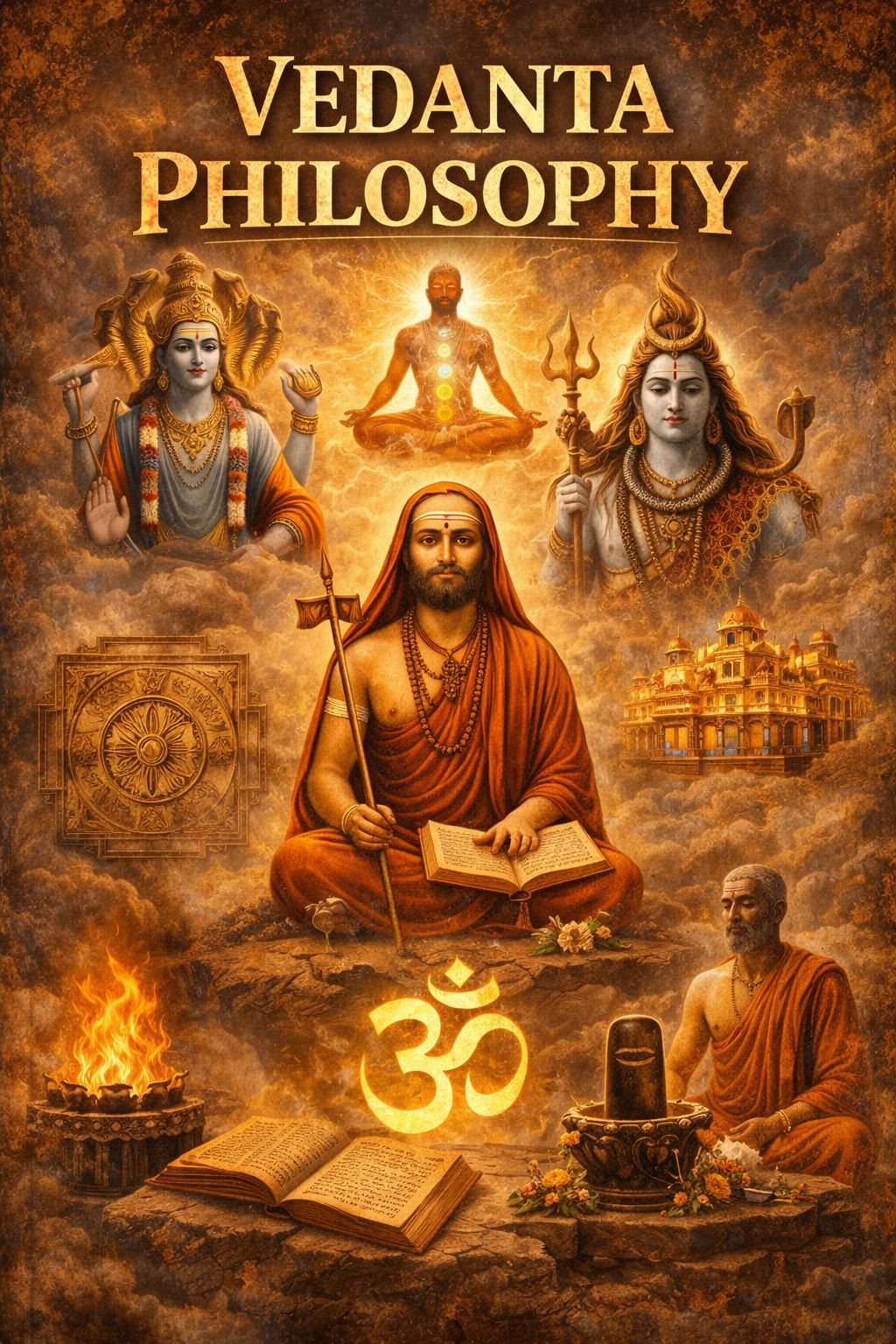
Introduction
There is a question that every human being asks — not once, not occasionally, but persistently, across every season of life, in the quiet spaces between one thought and the next.
Who am I?
Not your name. Not your profession. Not the story your family told about you or the identity your culture quietly assigned to you before you were old enough to question it. But the one who is asking. The one who has always been asking. The one who was present before the first thought arrived this morning and will still be present after the last thought dissolves tonight.
Vedanta philosophy is the most direct, most rigorous, and most complete answer that human civilisation has ever produced to that question. It does not ask you to believe anything on faith. It does not require ritual, renunciation, or the abandonment of your ordinary life. It asks only one thing — that you look. Honestly, carefully, and without flinching — at the nature of your own experience.
At Moksh Prapti, Vedanta philosophy is not an academic subject. It is the living centre of everything we do.
वेदांत दर्शन वह दर्पण है जिसमें आत्मा अपना असली स्वरूप पहचानती है — न कोई विश्वास चाहिए, न कोई अनुष्ठान — केवल सत्य की खोज।
Vedanta philosophy is the mirror in which the soul recognises its true nature — no belief required, no ritual needed — only the search for truth.
What Is Vedanta Philosophy — And Why Does It Matter Now
Vedanta philosophy is one of the six classical schools of Hindu thought, rooted in the Upanishads, the Bhagavad Gita, and the Brahma Sutras — collectively known as the Prasthanatrayi, the three foundational sources of Vedantic knowledge.
The word Vedanta carries the answer within it: Veda means knowledge, anta means end or culmination. Vedanta is therefore the culmination of all knowledge — the point at which intellectual inquiry dissolves into direct understanding of what you fundamentally are.
Its central teaching can be stated simply, though its depth is inexhaustible:
You are not the body. You are not the mind. You are the eternal, unchanging, self-luminous Consciousness — the Atman — which is not separate from the ultimate reality of the universe — Brahman.
Aham Brahmasmi — I am Brahman. Tat Tvam Asi — Thou art That. Prajnanam Brahma — Consciousness is Brahman. Ayam Atma Brahma — This Self is Brahman.
These four Mahavakyas — the Great Sayings of the Upanishads — are not poetic metaphors. They are precise philosophical statements about the nature of reality. And Vedanta philosophy is the systematic methodology for moving from intellectual understanding of these statements to direct, lived, unshakeable experience of their truth.
In a world drowning in information and starving for wisdom, Vedanta philosophy has never been more urgently needed.
5 Transformative Truths of Vedanta Philosophy for Modern Life
You Are Not Your Thoughts — You Are the One Who Watches Them
The single most liberating insight Vedanta philosophy offers the modern mind is this: you are not your thoughts. You are the awareness in which thoughts arise, play out, and dissolve — like clouds moving through an open sky.
The sky does not become a storm because a storm passes through it. The awareness that you are does not become anxious because an anxious thought arises within it.
Modern psychology has taken decades to arrive at a version of this insight — calling it defusion in Acceptance and Commitment Therapy, or decentring in Mindfulness-Based Cognitive Therapy. Vedanta philosophy stated it with complete precision over three thousand years ago.
When you begin to identify with the witness rather than the thought, something in your daily experience fundamentally changes. The internal weather still comes and goes. But you are no longer at its mercy.
The Self Is Eternal — Fear of Death Is Mistaken Identity
The Bhagavad Gita opens with Arjuna in complete psychological collapse — overwhelmed by grief, confusion, and the fear of loss. Krishna’s response, which forms the entire philosophical body of the Gita, begins with a single Vedantic truth:
Nainam chhindanti shastrani — weapons cannot cut the Self. Fire cannot burn it, water cannot wet it, wind cannot dry it. The Self was never born and will never die.
Vedanta philosophy teaches that the fear of death — which underlies most human anxiety, most compulsive behaviour, most of the grasping and avoidance that makes ordinary life so exhausting — is based on a fundamental misidentification. You have mistaken yourself for the body, which does indeed die. But you are not the body.
This is not consolation. This is not wishful thinking. This is the most carefully reasoned, most rigorously examined claim in the entire history of human philosophy — and it is available to be verified, directly, in your own experience.
Karma Is Not Punishment — It Is the Law of Conscious Cause and Effect
Vedanta philosophy situates karma not as cosmic retribution but as a precise, impersonal law: every action arising from avidya — from ignorance of the true Self — generates a corresponding consequence that must be experienced. Not as punishment. As education.
The modern world tends to experience life’s difficulties as either random misfortune or deserved suffering. Vedanta philosophy offers a third understanding — that every experience is an opportunity for the deepening of self-knowledge, that the curriculum of your life has been designed with extraordinary precision to bring you face to face with exactly what you most need to understand.
This understanding does not make suffering pleasant. But it makes it meaningful. And meaning, as every serious psychologist since Viktor Frankl has acknowledged, is the most powerful resource a human being possesses.
Moksha Is Not Somewhere Else — It Is the Recognition of What You Already Are
The goal of Vedanta philosophy is Moksha — liberation. And the most radical thing Vedanta says about liberation is this: it is not something you achieve. It is something you recognise.
You are already free. The bondage is not real — it is the appearance of bondage created by avidya, by the mistaken identification with the body-mind complex rather than the eternal Consciousness that you actually are.
This is why Vedanta philosophy says that Moksha cannot be earned through good deeds or accumulated through meditation alone. All spiritual practices are valuable — they purify the mind and make it receptive. But liberation itself is the recognition of a truth that was always already the case.
To explore how this understanding of Moksha connects to daily spiritual practice, read our complete guide on Vedanta Philosophy Explained for Modern Life — a step-by-step exploration of how Vedantic wisdom applies to the life you are living right now.
The Ancient Temples of India Are Vedanta Philosophy in Stone
Vedanta philosophy is not merely a textual tradition. It is an embodied one — and nowhere is this more powerfully demonstrated than in the ancient temples in India that have been transmitting Vedantic wisdom for centuries, not through words but through sacred geometry, sculpture, ritual, and silence.
The towering gopuram of a South Indian temple is a map of consciousness from the gross to the subtle to the transcendent. The garbhagriha — the inner sanctum, deliberately small, deliberately dark — represents the cave of the heart where the Self resides. The circumambulation of the deity is a physical enactment of the Vedantic principle that Consciousness is the centre around which all experience revolves.
To stand in the inner sanctum of Kashi Vishwanath, or before the Nataraja at Brihadeeswarar, or in the silent dawn of a Himalayan shrine, is to encounter Vedanta philosophy not as an idea but as a direct, living transmission — the kind that no book, however well written, can fully replicate.
The historical places in India are, at their deepest level, Vedanta philosophy made visible and permanently available to every seeker who approaches them with the right question.
What Vedanta Philosophy Teaches That Modern Psychology Is Still Learning
The modern world has invested enormously in the science of the mind — in neuroscience, psychology, psychiatry, and the vast self-help industry that has grown up around them. These disciplines have produced genuine, valuable insights.
But Vedanta philosophy begins where modern psychology ends.
Psychology, at its current frontier, asks: how do we reduce suffering? How do we function better? How do we manage our thoughts and emotions more effectively?
Vedanta philosophy asks a different question entirely: who is the one who is suffering? Who is it that thinks? Who is the one doing the managing?
And in pursuing that question — rigorously, honestly, and all the way to its conclusion — it arrives at an answer that does not merely reduce suffering. It dissolves the fundamental misidentification that makes suffering possible in the first place.
How Moksh Prapti Brings Vedanta Philosophy Into Your Life
At Moksh Prapti, Vedanta philosophy is not a subject we teach from a distance. It is the living pulse of everything we offer — from our written guides to our exploration of the historical places in India where this wisdom was first encoded in stone and sacred space.
We understand that most modern seekers do not have the luxury of spending years in an ashram or at the feet of a traditional teacher. Life is full. Responsibilities are real. The gap between the ancient world in which Vedanta philosophy flourished and the contemporary world in which you are reading these words is wide.
But Vedanta philosophy has always insisted that liberation is available here, now, in the life you are already living. Not after retirement. Not after the children grow up. Not after you have resolved every difficulty.
Now.
The Atman is not waiting for your circumstances to improve. It is already present, already free, already complete. The only thing required is the recognition. And that recognition can happen anywhere, at any time, in any life.
वेदांत दर्शन का सार यह है — मोक्ष कहीं बाहर नहीं, बल्कि उस चेतना में है जो अभी इन शब्दों को पढ़ रही है।
The essence of Vedanta philosophy is this — liberation is not somewhere outside, but in the Consciousness that is reading these words right now.
Conclusion
Vedanta philosophy is the most radical, most compassionate, and most complete answer to the deepest question a human being can ask.
It does not promise a better version of the life you have. It reveals that the one who has been seeking a better life — striving, grasping, achieving, losing, trying again — is not who you fundamentally are. And in that revelation, something relaxes that has been tensed for as long as you can remember.
The ancient temples in India carry this teaching in their stones. The historical places in India encode it in their geometry and their silence. The Upanishads, the Gita, the Brahma Sutras — all of it points, with one finger, in one direction.

