

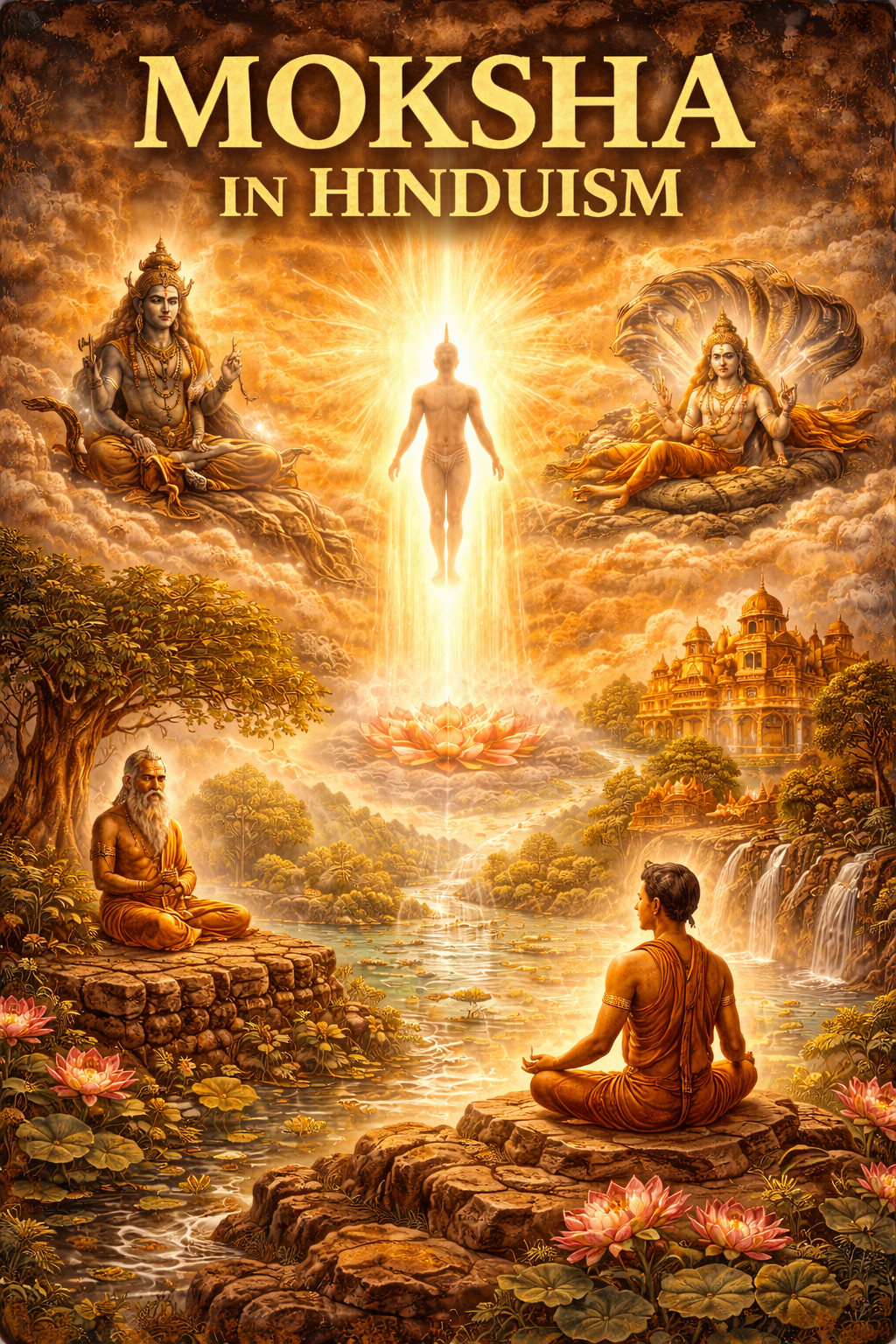
There is a longing that lives beneath every other longing.
Beneath the desire for love, for success, for security, for meaning — beneath all of it, quieter than all of it, there is something else. Something that no achievement has ever fully satisfied. Something that no relationship, no experience, no accumulation of any kind has ever permanently touched.
That longing is the soul’s memory of its own freedom.
Moksha in Hinduism is the name given to that freedom — not as a distant theological promise, but as the most immediate, most available, most urgently relevant truth in the entire canon of human wisdom. It is the liberation that ends not just this life’s suffering but the entire cycle of birth, death, and rebirth that has carried the soul through existence since before memory begins.
At Moksh Prapti, Moksha is not our subject. It is our name. It is the reason we exist.
मोक्ष कोई दूर का लक्ष्य नहीं है — यह उस चेतना की पहचान है जो सदा से मुक्त है, केवल अज्ञान के कारण बंधी हुई प्रतीत होती है।
Moksha is not a distant goal — it is the recognition of a Consciousness that has always been free, only appearing bound due to ignorance.
What Is Moksha in Hinduism — The Foundation
The word Moksha comes from the Sanskrit root muc — to release, to liberate, to set free. In Hindu philosophy, it is one of the four Purusharthas — the four aims of human life — alongside Dharma (righteous living), Artha (material prosperity), and Kama (desire and pleasure).
But Moksha is not simply the fourth aim on a list. It is the aim that gives meaning to all the others. It is the destination toward which all of human life — all its joys, all its sorrows, all its striving and resting and losing and finding — is ultimately oriented, whether or not the individual soul is yet aware of this.
Hindu philosophy is unambiguous about what Moksha is and what it is not.
Moksha in Hinduism is not:
- A place you go after death
- A reward for good behaviour
- A state of permanent emotional happiness
- The annihilation of the individual
Moksha in Hinduism is:
- The direct recognition of your true nature as pure, infinite, eternal Consciousness
- The permanent dissolution of the mistaken identification with the body-mind complex
- The end of karma and rebirth — not through escape but through understanding
- The realisation that liberation was never absent — only unrecognised
This distinction matters enormously. Moksha is not something you earn. It is something you recognise. And the entire apparatus of Hindu philosophy — the Vedas, the Upanishads, the Bhagavad Gita, the various schools of Vedanta — exists for one purpose: to facilitate that recognition.
The Four Paths to Moksha in Hinduism
Hindu philosophy has never insisted on a single road to liberation. It has always understood that human beings come with different temperaments, different strengths, different relationships to the sacred — and it has mapped, with extraordinary precision, the paths most suited to each.
Jnana Yoga — The Path of Knowledge
Jnana Yoga is the path of direct inquiry into the nature of the Self. It is the path most closely associated with Advaita Vedanta and with teachers like Adi Shankaracharya and, in the modern era, Ramana Maharshi.
The methodology is simple to describe and demanding to practice: you inquire, relentlessly and honestly, into the nature of the one who is seeking Moksha. Who is the seeker? What is the Self that is supposedly in bondage? Can you find it? Can you locate a separate, limited self anywhere in direct experience — or do you find, on honest investigation, only awareness itself, open and unbounded?
Shravana — hearing the truth from a qualified teacher. Manana — reflecting on it until every intellectual doubt is resolved. Nididhyasana — meditating on it until it becomes not a concept but a living, breathing, unshakeable recognition.
This is Jnana Yoga. And for the seeker with a sharp intellect and a genuine burning desire for liberation — mumukshutva — it is the most direct path to Moksha in Hinduism.
Bhakti Yoga — The Path of Devotion
Bhakti Yoga is the path of love — the dissolution of the separate self through complete, unconditional surrender to the Divine in whatever form most naturally calls to the heart.
The great bhaktas of India — Mirabai, Tukaram, Andal, Kabir, Chaitanya Mahaprabhu — did not arrive at Moksha through intellectual analysis. They arrived through love so total, so all-consuming, so utterly without reservation, that the boundary between the lover and the beloved simply dissolved.
In Advaita Vedanta, this dissolution is understood as the recognition of non-separation — the same recognition that Jnana Yoga arrives at through inquiry. The path is different. The destination is identical.
Bhakti does not require a sharp intellect. It requires an open heart. And for the seeker whose nature is devotional — whose relationship with the Divine is one of love rather than inquiry — it is among the most natural and most powerful paths to Moksha in Hinduism.
Karma Yoga — The Path of Selfless Action
Karma Yoga is the path of action performed without attachment to its fruits — every deed offered as an act of worship, every responsibility met as a form of spiritual practice, every moment of ordinary life transformed into sadhana.
The Bhagavad Gita is its supreme scripture. And its central teaching — stated by Krishna to Arjuna on the battlefield of Kurukshetra — is one of the most radical propositions in all of spiritual philosophy:
Yogah karmasu kaushalam — Yoga is excellence in action.
Not withdrawal from life. Not renunciation of responsibility. But the full, wholehearted engagement with every duty, every relationship, every challenge — performed from a place of inner stillness, without grasping for outcomes or contracting in fear of loss.
Karma Yoga does not require a monastery. It requires a kitchen, an office, a family, a life — and the willingness to meet all of it with complete presence and zero attachment. For the seeker whose life is full of worldly responsibility, it is the path that makes Moksha in Hinduism not a future possibility but a present reality.
Raja Yoga — The Path of Meditation
Raja Yoga — the royal path — is the systematic science of meditation described by the sage Patanjali in the Yoga Sutras. Through the progressive stilling of the mind’s fluctuations — chitta vritti nirodha — the Raja Yogi moves toward the direct experience of Samadhi, the state of complete absorption in pure Consciousness.
The eight limbs of Raja Yoga — from ethical restraint (yama and niyama) through physical posture (asana), breath control (pranayama), withdrawal of the senses (pratyahara), concentration (dharana), meditation (dhyana), and finally absorption (samadhi) — form a complete, integrated methodology for the purification of the mind and the direct experience of the Self.
Raja Yoga understands that Moksha in Hinduism is not a philosophical conclusion. It is an experience — and it requires systematic, sustained, disciplined inner practice to arrive at it.
Moksha, Karma, and the End of Rebirth
One of the most important aspects of Moksha in Hinduism is its relationship to karma and rebirth — the mechanism of samsara, the cycle of death and reincarnation that the soul moves through until liberation is achieved.
Every action performed from a place of ego-identification — from the mistaken belief that you are a separate, limited self — generates karma. Karma creates samskaras, impressions in the subtle body. Samskaras generate vasanas, tendencies and desires. Vasanas pull the soul back into incarnation, life after life, to exhaust those desires and learn the lessons they carry.
Moksha breaks this cycle — not by suppressing desire or accumulating enough good karma to outweigh the bad, but by dissolving the very identification that creates karma in the first place. When there is no longer a separate self that believes itself to be the doer of actions, actions no longer generate binding karma. The engine of samsara stops — not because it has been destroyed, but because the fuel of ego-identification has been exhausted through understanding.
This is why the soul in Hinduism is understood to have been journeying through countless lifetimes — not as punishment, but as the gradual ripening of the understanding that makes Moksha possible. Every life, every experience, every loss and gain and love and grief has been, in this understanding, a step in the soul’s education. And Moksha is the moment of graduation — the recognition that the student was always the teacher, and the seeker was always the sought.
For a complete understanding of how life after death in Hinduism connects to the journey toward Moksha — the intermediate states, the planes of existence, the role of karma in determining rebirth — read our detailed guide on Life After Death in Hinduism.
The Three Schools of Vedanta on Moksha
Hinduism is not a monolithic tradition, and its understanding of Moksha in Hinduism has been articulated through three primary schools of Vedantic philosophy — each offering a distinct, internally consistent, and philosophically rigorous account of what liberation means and how it is achieved.
Advaita Vedanta — the non-dual school of Adi Shankaracharya — holds that Moksha is the recognition of absolute identity between the individual Atman and Brahman, the ultimate reality. There is, in the deepest truth, only one Consciousness. The appearance of multiplicity — of individual souls, a creator God, and a created world — is Maya, a superimposition on that single, undivided reality. Liberation is the dissolution of the superimposition, the recognition of what was always already the case.
Vishishtadvaita — the qualified non-dualism of Ramanujacharya — holds that the individual soul and the world are real but exist as attributes of Brahman, the personal God Ishvara. Moksha in this school is not the dissolution of the individual soul into an impersonal Absolute but the soul’s eternal, conscious participation in the divine nature of Ishvara — a state of mukti described as salokya, samipya, sarupya, or sayujya, progressively deeper degrees of closeness to and union with the Divine.
Dvaita Vedanta — the dualist school of Madhvacharya — holds that the distinction between the individual soul, the world, and Brahman is real and eternal. Moksha here is not union with Brahman but the soul’s eternal, blissful dwelling in the presence of Vishnu — a liberation that preserves the individuality of the devotee in an eternal relationship of love and worship.
Three schools. Three accounts of Moksha in Hinduism. All three pointing, from different angles, at the same inexhaustible reality — that the soul’s deepest nature is not bondage but freedom, not separation but belonging, not ignorance but light.
Jivanmukti — Liberation While Living
One of the most extraordinary and distinctive concepts in the Hindu understanding of Moksha is Jivanmukti — liberation while still alive in the body.
The Jivanmukta is one who has achieved Moksha in Hinduism without waiting for death. The body continues to live out its remaining karma — what is called prarabdha karma, the karma already set in motion that must be experienced until its momentum is exhausted. But the inner identification with the body-mind complex has dissolved permanently. The Jivanmukta moves through the world like a ghost of the ego — fully functional, fully present, fully engaged — but no longer contracted into the belief that this particular body-mind is what they fundamentally are.
The great teachers of Vedanta — Ramana Maharshi, Nisargadatta Maharaj, Adi Shankaracharya — are understood within the tradition as Jivanmuktas. Their lives were not characterised by withdrawal, by blankness, or by an absence of human warmth. They were characterised by an extraordinary, unshakeable peace — and by a quality of presence so complete that simply sitting in their company was described by those who experienced it as itself a transmission of the recognition they embodied.
Jivanmukti makes Moksha in Hinduism not an otherworldly abstraction but a lived human possibility — available not only after death, not only in some future life, but here, in this body, in this lifetime, in the life you are already living.
How Moksh Prapti Walks This Path With You
At Moksh Prapti, we exist because we believe — with complete conviction — that Moksha in Hinduism is not the exclusive preserve of monks, renouncers, and cave-dwelling sages. It is the birthright of every human soul. Including yours.
The name Moksh Prapti means the attainment of liberation. Not as an aspiration. As a living commitment — to creating the conditions, the understanding, and the inner environment in which the recognition of Moksha becomes possible for every seeker who comes to us, regardless of where they are in their journey.
Whether you are approaching this for the first time, intellectually curious but spiritually unsettled — or whether you have been on this path for years and are looking for the final, direct pointing that dissolves the last traces of doubt — we are here.
The path to Moksha in Hinduism is not walked alone. It has always been walked in the company of teachers, of texts, of fellow seekers, and of the living tradition that has carried this understanding unbroken from the Upanishadic sages to the present day.
That company is what Moksh Prapti offers.
मोक्ष की राह अकेले नहीं चली जाती — सत्संग, सद्गुरु और सच्ची जिज्ञासा ही इस यात्रा के तीन स्तम्भ हैं।
The path to Moksha is not walked alone — true company, a genuine teacher, and sincere inquiry are the three pillars of this journey.
Conclusion
Moksha in Hinduism is the most radical, most compassionate, and most complete answer to the deepest question a human soul can ask.
It does not promise a better version of bondage. It does not offer a more comfortable cage. It points, with absolute directness and without compromise, at the recognition that the cage was never real — that the soul was always free, has always been free, and that every moment of apparent bondage was itself a step in the journey toward understanding this.
The longing you feel — beneath every other longing, quieter than every ambition and deeper than every fear — is not a problem to be solved. It is a compass. It is the soul’s own navigation system, pointing you, with extraordinary precision, toward the one recognition that will finally, permanently, completely satisfy it.
That recognition is Moksha. That recognition is Moksh Prapti.
You are already free. The only work is to recognise it.

