

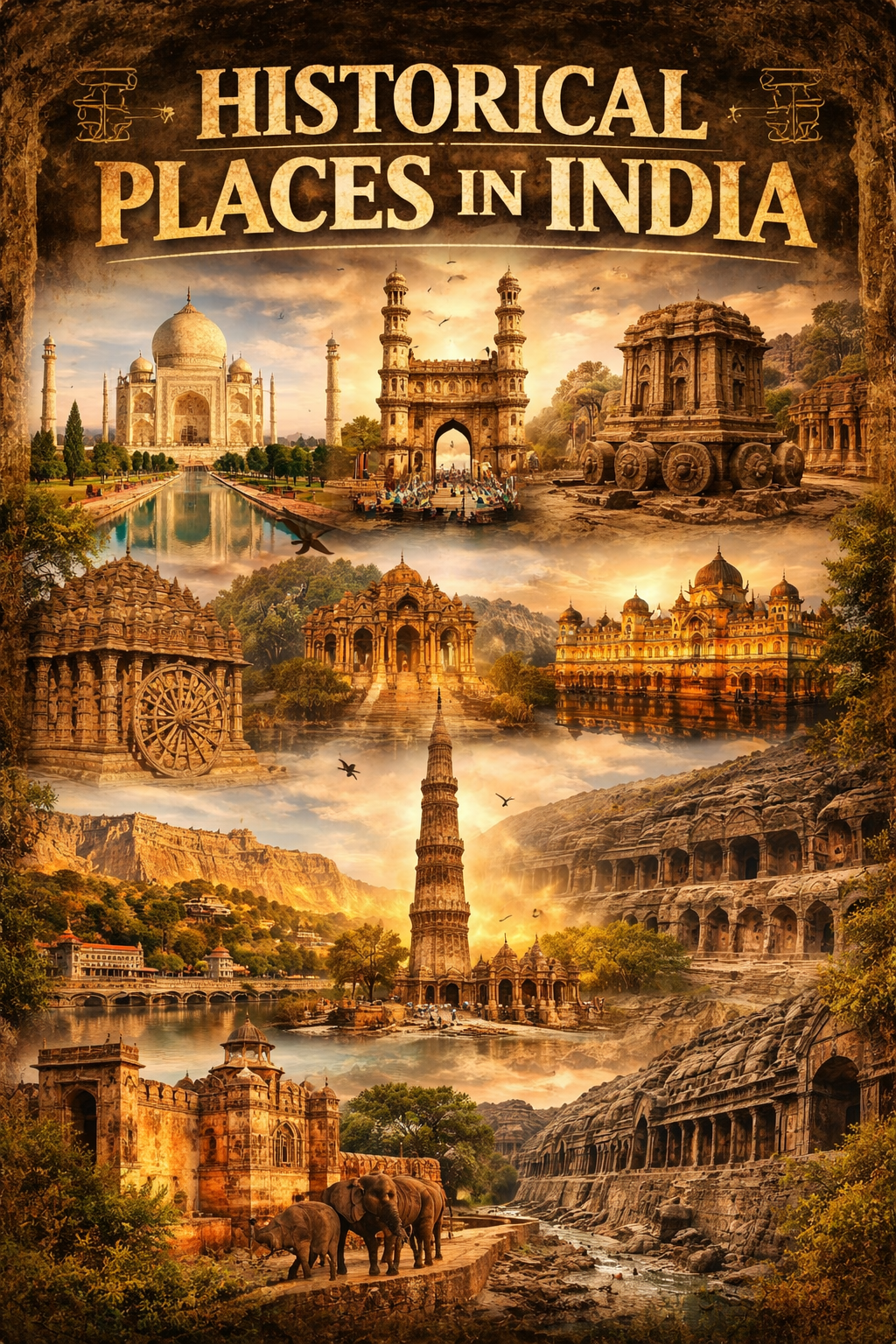
Introduction
Some places carry the weight of centuries in their stones.
You walk through a crumbling archway, run your hand along a wall carved a thousand years ago, and something shifts inside you — not dramatically, not with thunder and revelation, but quietly. A settling. A recognition. As though some part of you has been here before, or has always known that places like this exist, and has been waiting your whole life to finally stand inside one.
The historical places in India do this to people. Consistently. Across cultures, across beliefs, across every kind of personal background. They stop you. They slow you down. They remind you — in the most direct and physical way possible — that you are standing inside a story far larger than your own.
At Moksh Prapti, we believe that visiting the historical places of India is not an act of looking backward. It is an act of going deeper — into the civilisation that shaped this land, and into the Self that has always been at the centre of it.
इतिहास केवल बीता हुआ कल नहीं है — वह वर्तमान की नींव है और आत्मा की पहचान है।
History is not merely yesterday — it is the foundation of the present and the recognition of the soul.
Why Historical Places in India Are Unlike Anywhere Else on Earth
Every ancient civilisation has left behind ruins. Greece has its Parthenon. Egypt has its pyramids. Rome has its Colosseum. These are magnificent. They deserve every word of praise they receive.
But the historical places in India carry something that sets them apart from all of these — they are not ruins in the true sense of the word. They are not dead.
The temples still receive worshippers at dawn. The ghats still carry the smoke of evening aarti. The forts still echo with the footsteps of the living alongside the memory of the departed. India’s historical places have never stopped breathing — and that continuity, that unbroken thread of living practice running from the ancient world directly into the present day, is what makes them unlike anywhere else on earth.
Vedanta understands this continuity not as sentiment but as cosmic truth: Consciousness is unbroken. What was sacred ten thousand years ago remains sacred now. The form changes. The essence does not.
वेदांत कहता है — पवित्र स्थान वह है जहाँ चेतना जागृत हो जाए, चाहे वह कितना भी पुराना क्यों न हो।
Vedanta says — a sacred place is where Consciousness awakens, however ancient it may be.
7 Most Breathtaking Historical Places in India Every Seeker Must Visit
1️⃣ Hampi, Karnataka — A Kingdom Frozen in Time
There is a moment, walking through Hampi at golden hour, when the light falls across the boulder-strewn landscape in such a way that the boundary between past and present simply dissolves.
Hampi was the capital of the Vijayanagara Empire — once one of the wealthiest and most powerful kingdoms in the world, home to over half a million people at its peak in the 15th century. Its bazaars stretched for kilometres. Its temples gleamed with gold. Travellers from Persia and Portugal wrote home in disbelief at its magnificence.
In 1565, it was sacked and burned over six months by a coalition of Deccan Sultanates. What remains is extraordinary — over 1,600 surviving monuments spread across 41 square kilometres, including the magnificent Virupaksha Temple, which has been in continuous worship for over a thousand years.
The ancient temples in India at Hampi are not archaeological exhibits. They are living sacred spaces, still receiving devotees every single morning, within the ruins of a lost empire.
2️⃣ Varanasi, Uttar Pradesh — The Oldest Living City on Earth
Varanasi does not belong to history. History belongs to Varanasi.
Older than Rome, older than Athens, older than most cities that the Western world considers ancient — Varanasi has been continuously inhabited for at least 3,000 years, and by many scholarly estimates, considerably longer. Mark Twain, visiting in the 19th century, wrote that it was older than history, older than tradition, older even than legend.
The historical places in India do not get more layered than this. Every ghat along the Ganges is a palimpsest — centuries of worship, cremation, ritual, and daily life written one on top of the other in an endless, living manuscript.
To walk the ghats of Varanasi at dawn is to step directly into the forgotten history of India — not as a visitor to a museum, but as a participant in something that has never stopped.
3️⃣ Ajanta and Ellora Caves, Maharashtra — Art as Spiritual Transmission
Cut directly into the volcanic rock of the Sahyadri hills, the Ajanta and Ellora cave complexes represent one of the greatest artistic and spiritual achievements in human history.
Ajanta’s 30 caves, carved between the 2nd century BCE and 6th century CE, contain Buddhist murals of such extraordinary refinement that art historians consider them among the finest paintings ever created — anywhere, in any era. The brushwork is fluid, the expressions alive, the narratives drawn from the Jataka tales rendered with a psychological depth that feels startlingly contemporary.
Ellora’s 34 caves span three religions — Buddhism, Hinduism, and Jainism — all carved within a single hillside, side by side, in a demonstration of civilisational pluralism that the modern world has yet to fully replicate. The Kailasa Temple at Ellora — carved top-down from a single mountain of rock — remains the largest monolithic rock-cut structure on earth.
These are among the most astonishing historical places in India precisely because they reveal a civilisation that understood art not as decoration but as direct spiritual transmission — a carved wall as a portal to awakening.
4️⃣ Fatehpur Sikri, Uttar Pradesh — The City Built on a Blessing
Emperor Akbar built Fatehpur Sikri in 1571 in honour of the Sufi saint Sheikh Salim Chishti, who had blessed him with the son he desperately sought. He moved his entire imperial capital here from Agra — constructing mosques, palaces, courtyards, and audience halls of extraordinary beauty in Mughal-Rajput architectural fusion.
Fourteen years later, the city was abandoned. The official reason given is a shortage of water. But standing in its perfectly preserved courtyards, in the uncanny silence of a city that was built in full magnificence and then simply left, a different feeling rises — one of impermanence, of the fragility of even the greatest human ambitions.
Vedanta offers this teaching gently, through every crumbling monument and every deserted throne room: all forms are temporary. All empires rise and fall. The one who witnesses the rising and the falling — the eternal Self — alone remains.
The historical places in India carry this teaching more powerfully than any book.
5️⃣ Khajuraho, Madhya Pradesh — The Temple of All Human Experience
The temples of Khajuraho were built by the Chandela dynasty between 950 and 1050 CE. Of the original 85 temples, 25 survive — and their outer walls are covered in sculptures depicting every dimension of human experience: the spiritual and the sensual, the divine and the earthly, the transcendent and the deeply, uncomplicatedly human.
Western visitors have often fixated on the erotic carvings and missed the point entirely. The Khajuraho temples are not a celebration of desire. They are a map of the complete human being — one that does not ask us to suppress any part of our experience, but to bring all of it into consciousness and, through that consciousness, to move toward liberation.
This is Vedanta expressed not in words but in stone — and it is one of the most sophisticated philosophical statements in the entire canon of world art.
6️⃣ Mahabalipuram, Tamil Nadu — Where the Sea Swallowed a City
On the Coromandel Coast of Tamil Nadu, the shore temples of Mahabalipuram rise directly from the beach, waves breaking at their foundations as they have for over 1,300 years. Built by the Pallava dynasty in the 7th and 8th centuries CE, these are among the oldest surviving ancient temples in India — and their proximity to the ocean is not merely scenic. It is historically significant.
Local tradition has always spoken of six temples that once stood here — of which only one remains above water. In 2004, the tsunami temporarily drew back the sea along this coastline, and for a brief window of hours, the submerged ruins of ancient structures became visible offshore — stone walls, carved figures, and architectural elements lying on the ocean floor.
The forgotten history of India has a way of surfacing when you least expect it.
7️⃣ Rani Ki Vav, Patiala — A Temple Built Beneath the Earth
Most temples reach upward toward the sky. Rani Ki Vav — the Queen’s Stepwell — reaches downward into the earth.
Built in the 11th century by Queen Udaymati in memory of her husband King Bhimdev I of the Solanki dynasty, Rani Ki Vav is a seven-storey inverted temple descending 28 metres below ground, its walls carved with over 500 principal sculptures and more than a thousand minor ones. It was buried under silt for centuries, rediscovered only in the 1940s, and declared a UNESCO World Heritage Site in 2014.
The inversion is not merely architectural. It is philosophical. In a civilisation rooted in the Vedantic understanding that truth lies within — not above, not outside, not in the heavens but in the depths of one’s own being — a temple that descends into the earth rather than ascending toward the sky is a profound statement.
The most sacred direction, Vedanta reminds us, is always inward.
What the Historical Places of India Teach Us About Life
The historical places in India are not simply beautiful. They are instructive — in the deepest and most personal sense of that word. Taken together, they teach us:
- That civilisation at its greatest is always rooted in the sacred — that art, architecture, science, and governance flourish most fully when oriented toward consciousness rather than mere conquest
- That impermanence is not a tragedy — it is the very nature of all form, and understanding it is the beginning of freedom
- That the forgotten history of India is not gone — it lives in every stone, every carving, every flame still burning in temples built a thousand years ago
- That the ancient temples in India are not monuments to the past — they are living transmissions, active and available to every seeker who approaches them with an open heart
- That beauty is a path to truth — and that a civilisation capable of building Hampi, Ellora, Khajuraho, and Rani Ki Vav understood this at the deepest possible level
How Moksh Prapti Walks This Path With You
At Moksh Prapti, we understand that visiting the historical places of India is not leisure. It is sadhana — spiritual practice in the most direct and embodied form available to the modern seeker.
To understand how the Vedantic wisdom embedded in these historical sites applies to your daily life, read our guide on Vedanta Philosophy Explained for Modern Life — the same consciousness-based understanding carved into the walls of Khajuraho and encoded in the geometry of Ellora is alive and available to you right now, in the life you are already living.
The historical places of India do not ask you to be religious. They do not ask you to adopt a belief system or perform a ritual. They ask only one thing — that you show up, slow down, and pay attention.
Because in that attention, something ancient recognises something ancient. And in that recognition, the boundary between the seeker and the sought quietly, beautifully dissolves.
भारत के ऐतिहासिक स्थल केवल पत्थर नहीं हैं — ये वे दर्पण हैं जिनमें आत्मा अपना असली रूप देखती है।
The historical places of India are not merely stone — they are mirrors in which the soul sees its true form.
Conclusion
The historical places in India are waiting for you — not as a tourist attraction, not as an item on a bucket list, but as a genuine invitation to remember something you have always known.
Walk through Hampi at dawn. Stand at the edge of the sea at Mahabalipuram and watch the waves break against stone that has outlasted a dozen empires. Descend into Rani Ki Vav and feel the cool silence of the earth close around you. Look up at the ceiling of a cave at Ellora and meet the eyes of a figure painted fourteen centuries ago by a hand that understood, as yours does, what it means to be human and to seek the Divine.
The forgotten history of India is not behind you. The ancient temples of India are not behind you. They are here. Now. Alive.
And so are you.
That meeting — between the seeker and the sacred — is Moksh Prapti. That is what we are here for.
Visit. Remember. Return to yourself.

