

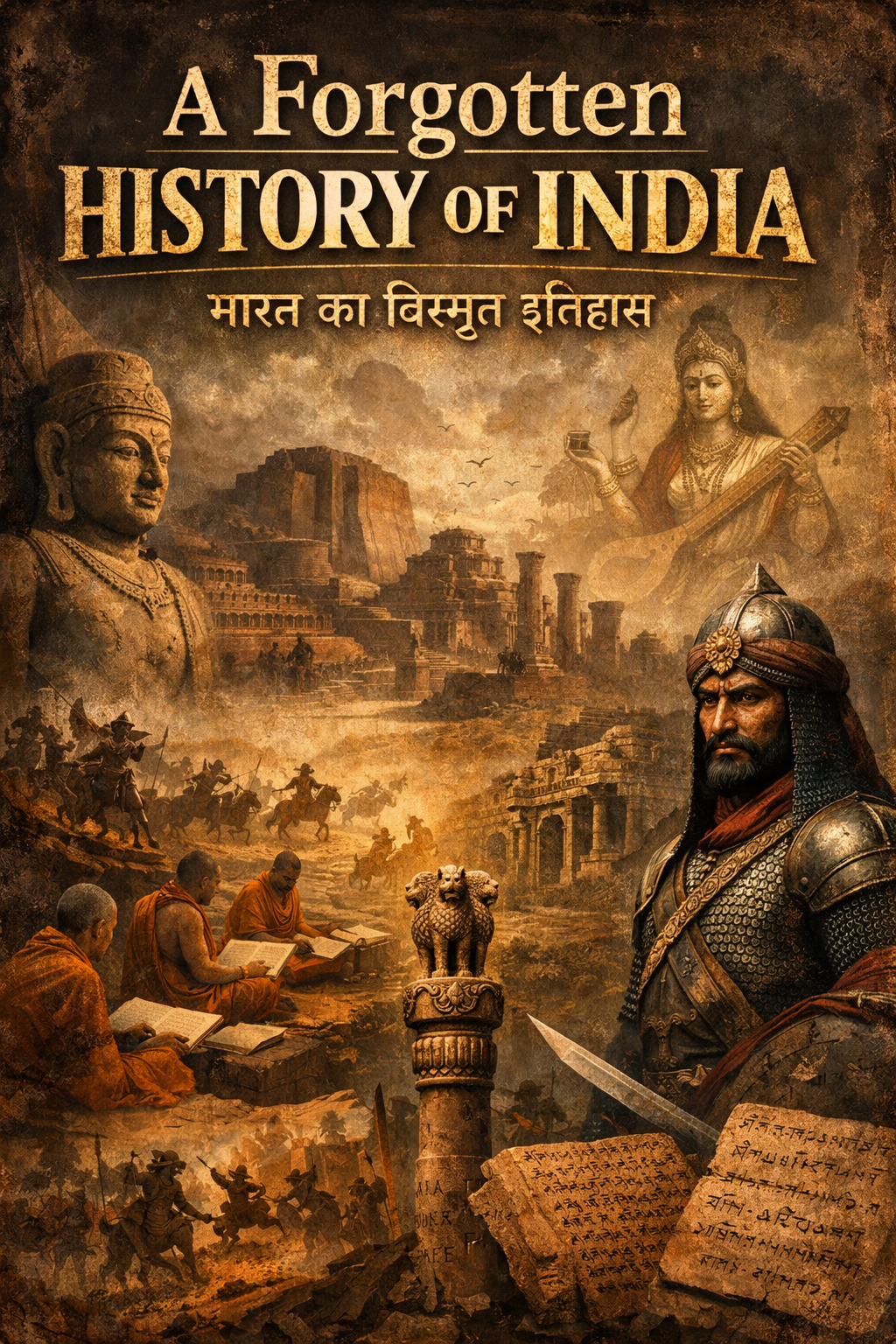
🪷 Introduction
The forgotten history of India is not lost. It is simply waiting. Waiting in the foundations of ancient temples in India that predate recorded civilization. Waiting in mathematical manuscripts that described gravity centuries before Newton. Waiting in cities swallowed by rivers and oceans that archaeologists are only now beginning to uncover.
History remembers the loudest voices. The conquerors, the dynasties, the wars that redrew borders and rewrote textbooks. But beneath all of that — older than any of it, quieter than all of it — lies another India entirely.
At Moksh Prapti, we believe that history is not merely the past. It is a mirror. And when you look into the forgotten history of India with honest eyes, what looks back at you is a civilisation of staggering depth — one that understood the nature of consciousness, cosmos, and the human soul long before the modern world began asking those questions.
वेदांत कहता है — जो भूला हुआ लगता है, वह वास्तव में भीतर ही संरक्षित है। इतिहास केवल बाहर नहीं, आत्मा में भी जीता है।
Vedanta says — what appears forgotten is actually preserved within. History lives not only outside, but within the soul.
🕉️ Why the Forgotten History of India Matters Today
We live in a civilisation that has developed a very short memory. Anything older than a century feels distant. Anything older than a millennium feels mythological — something to be admired in a museum but not taken seriously as living knowledge.
And yet the forgotten history of India keeps insisting otherwise.
The ancient temples in India were not merely places of worship — they were universities, observatories, hospitals, and philosophical academies, all contained within a single sacred structure. The gurukul system produced thinkers whose ideas on mathematics, astronomy, medicine, and consciousness have never been fully surpassed. The Indus Valley Civilisation built cities with drainage systems and urban planning that the Western world would not match for another three thousand years.
This is not nationalism. This is archaeology. This is documented fact.
And still it goes largely untold.
Vedanta has a word for this kind of forgetting: Avidya — ignorance not of facts, but of our own deepest nature. The forgotten history of India is, in many ways, a collective Avidya. And recovering it is a collective awakening.
🌿 7 Forgotten Chapters of India’s History That Will Astound You
1️⃣ The Underwater City of Dwarka — Krishna’s Lost Kingdom
Off the coast of Gujarat, beneath the waters of the Arabian Sea, lie the submerged ruins of an ancient city. Archaeologists from the Marine Archaeology Unit of India have documented stone walls, pillars, and structural foundations at depths of up to 40 metres — dating back potentially 9,000 to 12,000 years.
This is widely believed to be the ancient city of Dwarka — the legendary kingdom of Lord Krishna described in the Mahabharata.
For centuries, Dwarka was dismissed as mythology. The ocean floor said otherwise.
The ancient temples in India that line the coastline of modern Dwarka are not merely religious sites — they are the visible tip of a civilisation whose full depth is still being revealed, stone by submerged stone.
2️⃣ The Indus Valley Civilisation — The World’s First Urban Culture
At its peak around 2500 BCE, the Indus Valley Civilisation was the largest of the ancient world — larger than ancient Egypt and Mesopotamia combined. Its cities of Mohenjo-daro and Harappa had grid-planned streets, two-storey brick houses, public baths, and an advanced sewage system.
The forgotten history of India begins here — in a civilisation so sophisticated that modern urban planners study its layouts for lessons.
What is most astonishing is what archaeologists have not found: no weapons of mass warfare, no evidence of a ruling military class, no monuments to the glorification of kings. It was, by all available evidence, a remarkably egalitarian society. A civilization that seemed to understand something about collective living that we are still struggling to relearn.
3️⃣ Nalanda University — The World’s First International University
Before Oxford. Before Bologna. Before any European university existed, Nalanda stood in present-day Bihar as the greatest centre of learning the ancient world had ever seen.
Founded in the 5th century CE, Nalanda hosted over 10,000 students and 2,000 faculty at its height — scholars arriving from China, Korea, Japan, Tibet, Persia, and Greece. Its library, the Dharmaganj, contained three buildings of nine storeys each, housing hundreds of thousands of manuscripts.
In 1193 CE, it was burned to the ground by the forces of Bakhtiyar Khilji. Accounts suggest the library burned for three months.
The forgotten history of India holds no greater tragedy than Nalanda. And no greater lesson about the fragility of knowledge — and the absolute necessity of preserving it.
To understand how the spiritual wisdom taught at Nalanda connects to daily life, read our guide on Vedanta Philosophy Explained for Modern Life — the same consciousness-based understanding that filled those nine-storey libraries is still available to every seeker today.
4️⃣ Aryabhata and the Zero — India’s Gift to All Mathematics
In 499 CE, a mathematician and astronomer named Aryabhata wrote a text called the Aryabhatiya. In it, he calculated the value of pi to four decimal places, described the Earth as a sphere rotating on its axis, explained solar and lunar eclipses through geometry, and laid the foundations for algebra and trigonometry.
He did all of this a thousand years before Europe reached the same conclusions.
The concept of zero — shunya — which makes all modern mathematics, computing, and digital technology possible, originated in India. Without the Indian invention of zero, there is no binary code. There is no computer. There is no internet. There is no smartphone in your hand as you read this.
The forgotten history of India is not merely a matter of cultural pride. It is a debt that the entire modern world carries.
5️⃣ The Ancient Temples of India as Living Universities
The ancient temples in India have always been more than places of prayer. The great temple complexes of South India — Brihadeeswarar, Meenakshi, Virupaksha — functioned as the civic, economic, intellectual, and spiritual centres of their civilisations simultaneously.
Temple walls were textbooks. The sculptures carved into their surfaces encoded knowledge of astronomy, medicine, music, dance, statecraft, and philosophy in visual form — accessible to the literate and illiterate alike. The agamas, the sacred texts governing temple construction, specified proportions based on mathematical and cosmological principles that aligned structures with planetary movements.
The forgotten history of India’s ancient temples is the history of a civilisation that understood something modern education systems are only beginning to grasp: that knowledge divorced from consciousness is incomplete. That the head and the heart must be educated together.
6️⃣ The Surya Siddhanta — India’s Ancient Astronomical Bible
Written approximately 1,500 years ago, the Surya Siddhanta calculated the diameter of the Earth as 7,840 miles. The actual diameter is 7,926 miles — an error of less than 1%.
It calculated the length of a solar year as 365.2563 days. Modern science gives 365.2564 days.
It described the orbits of planets, the precession of the equinoxes, and the movement of celestial bodies with an accuracy that would not be matched by Western astronomy until the 17th century — using instruments made entirely of wood, water, and shadow.
The forgotten history of India is filled with achievements like this — precise, documented, and almost entirely absent from the global scientific narrative.
7️⃣ The Yoga Sutras and the Science of Consciousness
While the West was centuries away from developing psychology as a formal discipline, the sage Patanjali had already written the Yoga Sutras — a systematic, clinical map of the human mind, its fluctuations, its patterns, its suffering, and the precise methodology for moving beyond all of it.
The Yoga Sutras are not a spiritual self-help book. They are a scientific treatise on consciousness — one that modern neuroscience and psychology are only now beginning to validate through brain imaging, clinical trials, and mindfulness research.
The forgotten history of India is, in its deepest layer, the history of a civilisation that turned its greatest intellectual energy not outward toward conquering the physical world, but inward toward understanding the nature of the mind and the Self.
In this sense, it was not behind the modern world. In many ways, it was ahead of it.
🔥 What the Forgotten History of India Teaches Us About Ourselves
The forgotten history of India is not an exercise in nostalgia. It is not about reclaiming past glory or settling historical scores. It is about something far more immediate and personal.
It teaches us:
- That human potential is far greater than our current civilisation demonstrates — that minds without modern technology mapped the cosmos with extraordinary precision
- That consciousness-based knowledge produces lasting wisdom — while purely material knowledge produces power without peace
- That what is forgotten can be recovered — not just in libraries and excavations, but in the lived experience of every seeker who goes inward
- That the ancient temples in India are not ruins — they are living transmissions from a civilisation that understood something we urgently need to remember
- That history is not behind us — it is within us, waiting to be awakened
🧘 How Moksh Prapti Reconnects You to This Living Heritage
At Moksh Prapti, we do not teach history as information. We offer it as recognition — the experience of reading about something ancient and feeling, somewhere beneath the intellect, that you already knew it.
Because according to Vedanta, you did.
The Atman — the eternal Self — carries within it the imprint of every civilisation, every insight, every moment of genuine human awakening. The forgotten history of India is not something that happened to someone else, long ago, far away. It is the story of what human consciousness is capable of when it turns toward truth without flinching.
The ancient temples in India, the submerged cities, the burned libraries, the mathematical revelations — all of it points in the same direction. Inward. Always inward.
भारत का भूला हुआ इतिहास केवल पत्थरों में नहीं, हर साधक की आत्मा में जीवित है।
The forgotten history of India lives not only in stone — it lives in the soul of every seeker.
🌈 Conclusion
The forgotten history of India is not a wound. It is a treasure — one that the world is only beginning to rediscover, and one that every individual seeker can access directly through the living traditions of Vedanta, yoga, and sacred pilgrimage.
Go stand before the ancient temples of India. Walk the streets of Varanasi. Sit where Nalanda once stood. Look at the night sky and remember that an Indian mathematician calculated its movements with extraordinary precision fifteen centuries ago, without a single instrument that required electricity.
And then ask yourself — not as a matter of history, but as a matter of lived, personal truth — what else has been forgotten? What else is waiting, inside you, to be remembered?
That remembering is Moksh Prapti. That is what we are here for.
Reclaim your history. Reclaim your Self.

