Moksha in Hinduism — The Ultimate Freedom Every Soul Is Searching For
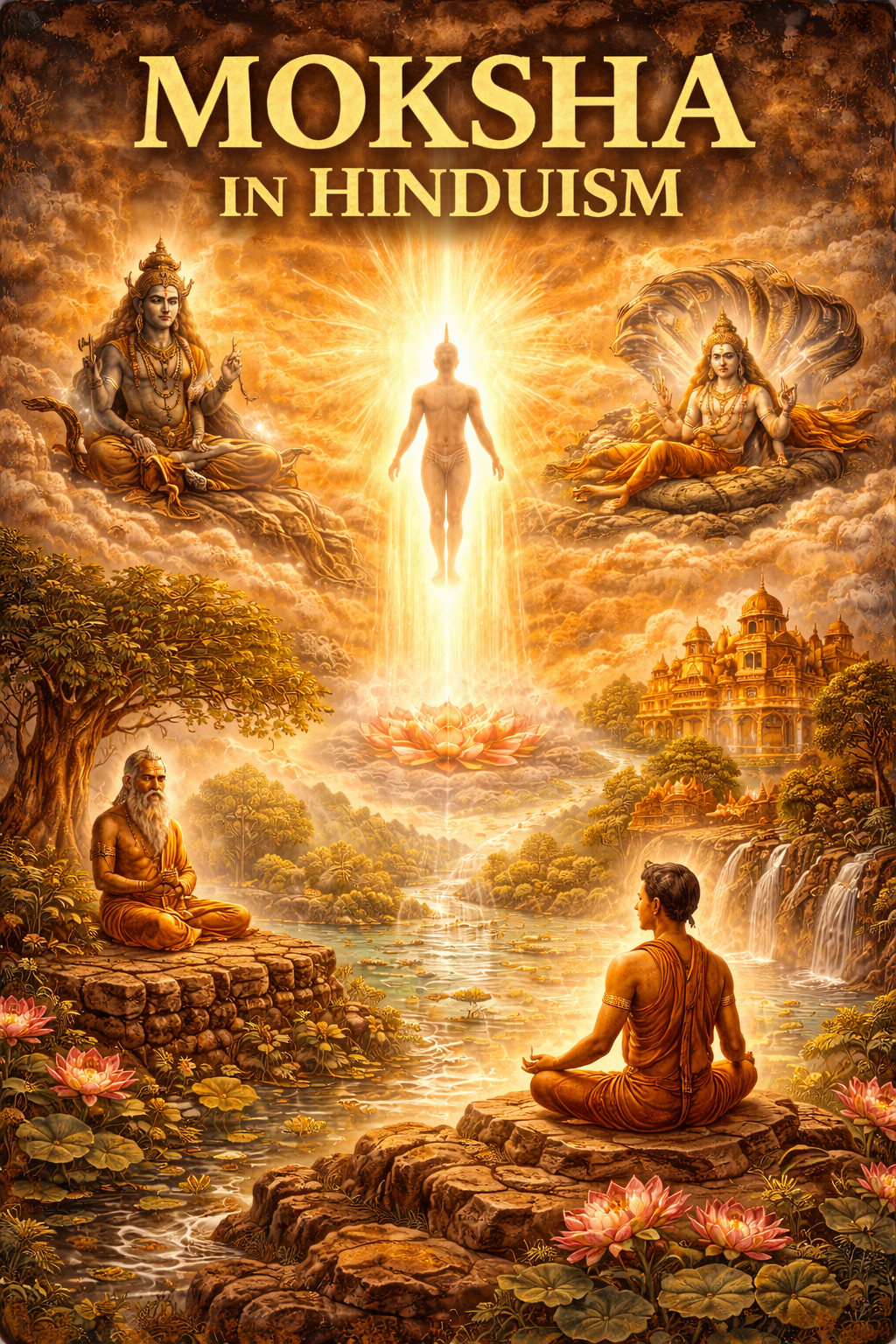
There is a longing that lives beneath every other longing. Beneath the desire for love, for success, for security, for meaning — beneath all of it, quieter than all of it, there is something else. Something that no achievement has ever fully satisfied. Something that no relationship, no experience, no accumulation of any kind has ever permanently touched. That longing is the soul’s memory of its own freedom. Moksha in Hinduism is the name given to that freedom — not as a distant theological promise, but as the most immediate, most available, most urgently relevant truth in the entire canon of human wisdom. It is the liberation that ends not just this life’s suffering but the entire cycle of birth, death, and rebirth that has carried the soul through existence since before memory begins. At Moksh Prapti, Moksha is not our subject. It is our name. It is the reason we exist. मोक्ष कोई दूर का लक्ष्य नहीं है — यह उस चेतना की पहचान है जो सदा से मुक्त है, केवल अज्ञान के कारण बंधी हुई प्रतीत होती है। Moksha is not a distant goal — it is the recognition of a Consciousness that has always been free, only appearing bound due to ignorance. What Is Moksha in Hinduism — The Foundation The word Moksha comes from the Sanskrit root muc — to release, to liberate, to set free. In Hindu philosophy, it is one of the four Purusharthas — the four aims of human life — alongside Dharma (righteous living), Artha (material prosperity), and Kama (desire and pleasure). But Moksha is not simply the fourth aim on a list. It is the aim that gives meaning to all the others. It is the destination toward which all of human life — all its joys, all its sorrows, all its striving and resting and losing and finding — is ultimately oriented, whether or not the individual soul is yet aware of this. Hindu philosophy is unambiguous about what Moksha is and what it is not. Moksha in Hinduism is not: Moksha in Hinduism is: This distinction matters enormously. Moksha is not something you earn. It is something you recognise. And the entire apparatus of Hindu philosophy — the Vedas, the Upanishads, the Bhagavad Gita, the various schools of Vedanta — exists for one purpose: to facilitate that recognition. The Four Paths to Moksha in Hinduism Hindu philosophy has never insisted on a single road to liberation. It has always understood that human beings come with different temperaments, different strengths, different relationships to the sacred — and it has mapped, with extraordinary precision, the paths most suited to each. Jnana Yoga — The Path of Knowledge Jnana Yoga is the path of direct inquiry into the nature of the Self. It is the path most closely associated with Advaita Vedanta and with teachers like Adi Shankaracharya and, in the modern era, Ramana Maharshi. The methodology is simple to describe and demanding to practice: you inquire, relentlessly and honestly, into the nature of the one who is seeking Moksha. Who is the seeker? What is the Self that is supposedly in bondage? Can you find it? Can you locate a separate, limited self anywhere in direct experience — or do you find, on honest investigation, only awareness itself, open and unbounded? Shravana — hearing the truth from a qualified teacher. Manana — reflecting on it until every intellectual doubt is resolved. Nididhyasana — meditating on it until it becomes not a concept but a living, breathing, unshakeable recognition. This is Jnana Yoga. And for the seeker with a sharp intellect and a genuine burning desire for liberation — mumukshutva — it is the most direct path to Moksha in Hinduism. Bhakti Yoga — The Path of Devotion Bhakti Yoga is the path of love — the dissolution of the separate self through complete, unconditional surrender to the Divine in whatever form most naturally calls to the heart. The great bhaktas of India — Mirabai, Tukaram, Andal, Kabir, Chaitanya Mahaprabhu — did not arrive at Moksha through intellectual analysis. They arrived through love so total, so all-consuming, so utterly without reservation, that the boundary between the lover and the beloved simply dissolved. In Advaita Vedanta, this dissolution is understood as the recognition of non-separation — the same recognition that Jnana Yoga arrives at through inquiry. The path is different. The destination is identical. Bhakti does not require a sharp intellect. It requires an open heart. And for the seeker whose nature is devotional — whose relationship with the Divine is one of love rather than inquiry — it is among the most natural and most powerful paths to Moksha in Hinduism. Karma Yoga — The Path of Selfless Action Karma Yoga is the path of action performed without attachment to its fruits — every deed offered as an act of worship, every responsibility met as a form of spiritual practice, every moment of ordinary life transformed into sadhana. The Bhagavad Gita is its supreme scripture. And its central teaching — stated by Krishna to Arjuna on the battlefield of Kurukshetra — is one of the most radical propositions in all of spiritual philosophy: Yogah karmasu kaushalam — Yoga is excellence in action. Not withdrawal from life. Not renunciation of responsibility. But the full, wholehearted engagement with every duty, every relationship, every challenge — performed from a place of inner stillness, without grasping for outcomes or contracting in fear of loss. Karma Yoga does not require a monastery. It requires a kitchen, an office, a family, a life — and the willingness to meet all of it with complete presence and zero attachment. For the seeker whose life is full of worldly responsibility, it is the path that makes Moksha in Hinduism not a future possibility but a present reality. Raja Yoga — The Path of Meditation Raja Yoga — the royal path — is the systematic science of meditation described by the sage Patanjali in the Yoga Sutras. Through the progressive
Moksha in Hinduism — The Ultimate Freedom Every Soul Is Searching For Read More »