

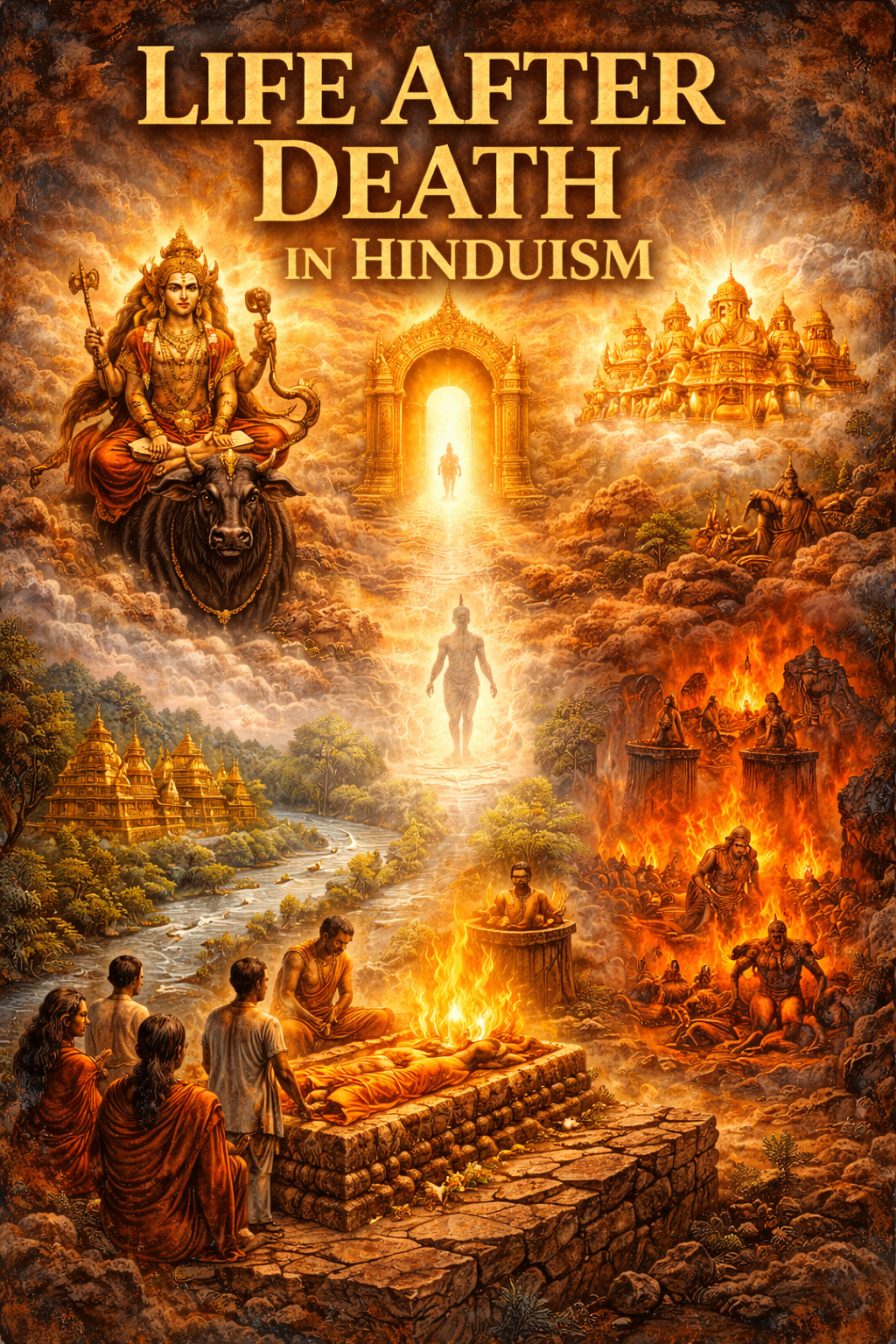
Introduction
Death is the one appointment none of us can cancel.
Every human civilisation that has ever existed has tried to understand it — to make peace with it, to explain it, to look it directly in the face without flinching. And across thousands of years of philosophical inquiry, no tradition has examined the question of what happens after death with more depth, more rigour, or more unflinching honesty than Hinduism.
Life after death in Hinduism is not a single, simple doctrine. It is a vast, layered, extraordinarily sophisticated understanding of the soul, its journey, and the ultimate nature of existence — one that encompasses reincarnation, karma and rebirth, the subtle body, the various planes of existence, and the final liberation that ends the cycle of birth and death altogether.
At Moksh Prapti, we do not approach this subject as theology or consolation. We approach it as the most important philosophical inquiry a human being can undertake — because how you understand death determines, more than almost anything else, how you understand life.
मृत्यु जीवन का अंत नहीं है — वह उस यात्रा का एक पड़ाव है जो आत्मा अनंत काल से कर रही है।
Death is not the end of life — it is a waystation on a journey the soul has been making since before time began.
What Does Hinduism Say About Life After Death
Before exploring the specifics, it is important to understand the philosophical foundation on which the Hindu understanding of life after death rests.
Hinduism does not believe that you are a body that has a soul. It teaches the precise opposite — that you are a soul, a pure and eternal Consciousness, temporarily inhabiting a body. The body is an instrument. The soul is the musician. When the instrument wears out, the musician does not cease to exist. The musician moves on.
This is the bedrock of the Hindu understanding of the soul in Hinduism. Everything else — the karma and rebirth, the subtle planes, the ancestral realms, the final liberation — is built on this single, unshakeable foundation.
The Bhagavad Gita states it plainly in the second chapter:
Vasamsi jirnani yatha vihaya — just as a person puts on new garments after discarding worn-out ones, the soul accepts new material bodies after casting off the old and useless ones.
Death, in the Hindu understanding, is not a full stop. It is a comma.
The Journey of the Soul After Death — Step by Step
The Moment of Death
At the moment of death, the sukshma sharira — the subtle body — separates from the sthula sharira, the gross physical body. The subtle body carries with it the chitta, the accumulated impressions of all thoughts, desires, actions, and karmic residue from the life just lived.
The Garuda Purana, one of the primary Hindu scriptural sources on life after death in Hinduism, describes this separation in extraordinary detail — the withdrawal of the senses, the gathering of the vital forces, and the departure of the soul through one of the body’s nine gates, the specific gate depending on the level of consciousness achieved at the moment of death.
This is why Hinduism places such profound importance on the state of mind at the moment of dying — and why Hindu rituals surrounding death, the chanting of the divine name, the presence of sacred sounds, and the maintenance of a peaceful environment around the dying person are considered so deeply significant across all Hindu traditions.
The Intermediate State — Pitru Loka and Beyond
After leaving the body, the soul in Hinduism does not immediately reincarnate. It passes through an intermediate state — described in different texts as Pitru Loka, the realm of the ancestors, or Yamaloka, the realm presided over by Yama, the lord of death and dharma.
In this intermediate state, the accumulated karma of the life just completed is processed. The soul experiences the consequences — both pleasant and unpleasant — of its actions from the previous life. The duration of this intermediate state varies according to the karmic weight being carried.
The shraddha rituals — among the most important Hindu rituals connected to life after death — performed by surviving family members are not mere sentiment or superstition. The offering of water, sesame seeds, and food to the ancestors is understood in Hindu philosophy as a genuine energetic support to the soul during this transitional phase, an act of love that crosses the boundary between the living and the departed.
Karma and Rebirth — The Soul’s Return
When the karmic residue of the intermediate state has been fully experienced, the soul returns to the physical plane — taking birth in a new body, in circumstances precisely aligned with the unresolved karma and unfulfilled desires carried forward from previous lives.
This is punarjanma — rebirth. And the Hindu understanding of karma and rebirth is not a random lottery. It is a deeply purposeful, intelligently ordered process in which the soul is given, life after life, exactly the experiences it needs to exhaust its accumulated karma and move progressively toward self-knowledge.
The form of the next birth — human, animal, or divine — is determined by the dominant tendencies of consciousness at the time of death. This is why the Upanishads and the Gita place such emphasis on the cultivation of sattva — purity, clarity, and wisdom — as the governing quality of one’s inner life.
For a deeper understanding of how karma operates across lifetimes and how it shapes every dimension of human experience, read our complete guide on Vedanta Philosophy for Modern Life — a detailed exploration of how the law of conscious cause and effect can be understood and worked with in daily living.
The Planes of Existence — Heaven, Hell, and Everything Between
Hinduism describes multiple planes of existence — lokas — through which the soul may travel between incarnations. Swarga — often translated as heaven — is not a permanent destination but a temporary realm of refined experience available to souls whose accumulated merit grants them a period of elevated existence before their next incarnation.
Similarly, Naraka — the hellish realms — are not eternal damnation in the Abrahamic sense. They are temporary states of intense karmic processing — experiences of suffering proportional to the harm caused during life — after which the soul returns again to the cycle of karma and rebirth.
The crucial point, repeated consistently across Hindu scriptural sources on life after death in Hinduism, is this: no state other than Moksha is permanent. Heaven and hell alike are temporary. The soul will return. The journey continues until liberation is achieved.
Moksha — The End of the Cycle
Moksha is the ultimate destination of the soul in Hinduism — liberation from the cycle of birth, death, and rebirth altogether. It is not a place. It is a state of being — the full, direct, unmediated recognition of one’s true nature as pure, infinite, eternal Consciousness.
In the Advaita Vedanta tradition, Moksha is the recognition that the individual soul — the Atman — is not separate from Brahman, the ultimate reality. The apparent separation was always Maya — a perceptual superimposition on a reality that was always, from the very beginning, one.
When this recognition dawns — not as an intellectual conclusion but as a direct, lived, unshakeable experience — the karmic engine stops. There is no longer a separate self to accumulate karma. There is no longer a contracted identity to take birth again. The drop has recognised itself as the ocean. The journey home is complete.
The Role of Hindu Rituals in Supporting the Soul After Death
No discussion of life after death in Hinduism is complete without understanding the role that Hindu rituals play in supporting the soul’s onward journey.
The antyesti — the last rites — are considered one of the sixteen samskaras, the sacred milestones of Hindu life. Cremation is preferred in most Hindu traditions precisely because of its philosophical significance: fire is understood as the purifying element that releases the subtle body from its attachment to the gross physical form, accelerating the soul’s transition.
The thirteen-day mourning period following death — culminating in the tehravi ritual — is not merely social custom. It is a structured period of prayer, scripture recitation, and conscious holding of the departing soul in sacred intention, creating a field of spiritual support for the transition being undergone.
The pitru paksha — the fortnight of the ancestors observed each year in the Hindu calendar — extends this support annually, as the living perform shraddha rituals for departed family members across generations. The understanding that the living and the departed remain in relationship, and that conscious, loving attention across that boundary is both possible and meaningful, is one of the most distinctive and deeply human aspects of the Hindu understanding of life after death.
What the Sacred Geography of India Reveals About Death and Liberation
India’s sacred geography has always been organised around the understanding of life after death in Hinduism. The placement of the great pilgrimage sites — the char dham, the jyotirlingas, the shakti peethas — maps directly onto the Hindu understanding of the soul’s journey and the conditions most conducive to liberation.
Varanasi holds a unique position in this geography. It is understood in Hindu tradition as the city where Shiva himself whispers the Taraka mantra — the mantra of liberation — into the ear of every soul that departs within its boundaries. To die in Kashi is to receive Shiva diksha — direct initiation into liberation — regardless of one’s karmic accumulation.
This is not superstition. It is a profound statement about the power of sacred space, sacred sound, and the accumulated spiritual energy of thousands of years of conscious practice concentrated in a single geographic location.
The spiritual significance of pilgrimage in Hinduism is inseparable from its understanding of death — because the pilgrim, in the Hindu tradition, is always practicing for the final journey. Every act of leaving home, surrendering comfort, walking toward the sacred, and returning transformed is a rehearsal for the soul’s ultimate departure and return.
How Moksh Prapti Walks This Understanding With You
At Moksh Prapti, we hold the question of life after death in Hinduism not as a theological puzzle to be solved but as a deeply personal and immediate inquiry to be lived.
Because the question of what happens after death is inseparable from the question of what is actually alive right now. If you understand what you truly are — if the direct recognition that Vedanta points to becomes your living experience rather than a philosophical position — then death loses its sting. Not through denial. Not through distraction. But through the clear-eyed understanding that what you fundamentally are cannot die.
That understanding is available. It has always been available. The scriptures, the teachers, the Hindu rituals, the sacred geography of this land — all of it is pointing, with extraordinary consistency and across thousands of years, at a single truth.
You are not the one who dies. You are the one who watches — the eternal, unborn, undying Consciousness in which birth and death both appear, like waves on the surface of an ocean that remains, beneath every storm, perfectly still.
आत्मा न जन्मती है, न मरती है — वह केवल देह बदलती है, जैसे मनुष्य वस्त्र बदलता है।
The soul is neither born nor dies — it only changes bodies, as a person changes clothes.
Conclusion
Life after death in Hinduism is not a comforting story told to frightened people. It is a rigorous, internally consistent, philosophically profound account of the soul’s journey — from ignorance to knowledge, from bondage to liberation, from the appearance of separation to the recognition of unity.
It tells us that death is not the end. That karma and rebirth are not a curse but an education. That the soul in Hinduism is not a religious concept but a direct, verifiable reality. And that Moksha — the liberation that ends the cycle altogether — is not a distant dream reserved for saints and sages but the birthright of every soul, available in this very life, to anyone with the courage and clarity to look directly at what they actually are.
The soul knows the way home. It has always known.
That homecoming is Moksh Prapti. That is what we are here for.
The journey does not end at death. It ends at liberation. And liberation begins now.

